Woodworking Table Saws for a Home Shop: A Plain Guide
A woodworking table saw for a home shop should fit your work, space and power supply. Most home woodworkers can start with a portable jobsite saw; choose a contractor or hybrid model when you have room for a larger, more stationary setup.
On this page (9 sections)
- What kind of woodworking table saw fits a home shop?
- How should you match a saw to your projects?
- How much room does a home-shop saw need?
- Which features matter most for woodworking?
- Which woodworking table saw options suit a home shop?
- What power and dust setup should you plan?
- How do you choose between portable and fixed setups?
- What safety checks belong in your setup?
- What should you choose for your home shop?
A woodworking table saw for a home shop should fit the cuts you make, the room you have and the way you work. For many hobby shops, a portable jobsite saw is a sensible starting point; a contractor or hybrid saw can suit a dedicated space and larger routine workloads.
Before choosing, list the stock you cut most, the widest rip you need and how often you need to move the saw. Then check available space for the saw, long workpieces and outfeed support.
This guide compares the main saw types, key features and four options for different home-shop needs. For a product-focused shortlist, see our best table saws for woodworking.
What kind of woodworking table saw fits a home shop?
A portable jobsite saw works well when storage and mobility matter. A contractor or hybrid saw is worth considering when the saw can stay set up and you want a more permanent station.
| Saw type | A good fit when | Check before choosing |
|---|---|---|
| Compact or mini | Your work is small and space is very limited | Cutting capacity and compatibility with your stock |
| Jobsite | You need a portable saw for general shop work | Stand, fence range and support for long stock |
| Contractor | You have room for a larger, stationary setup | Footprint, electrical needs and dust collection |
| Hybrid | You want a fixed shop saw with a more substantial setup | Space, delivery route and the model's power requirements |
These labels are broad categories, not a promise that every saw in one group has the same capacity or features. Compare each model's dimensions, fence travel, cut depth and included support.
A contractor table saw is designed around a more stationary setup than a typical jobsite model. A hybrid table saw may be a better fit if you want a fixed shop machine, but its space and power needs still depend on the specific saw.
How should you match a saw to your projects?
Choose a saw by the widest, thickest and longest material you expect to cut regularly. Occasional projects can use auxiliary support, but routine cuts should fit the saw and your shop layout without awkward handling.
Write down the common stock dimensions before shopping. Include plywood or sheet goods if you plan to break them down on the saw, since large panels need steady support on both sides of the blade.
A saw's rip capacity describes the distance available between the blade and fence for ripping. It does not tell you whether you have room to control a full sheet safely.
See our guide to table saw rip capacity for help matching fence reach to your projects.
For thick stock or frequent bevel cuts, compare the model's published cut depth at 90 and 45 degrees. Also confirm which blades, dado sets and inserts the saw accepts instead of assuming accessories fit across models.
Does a 10-inch woodworking table saw make sense?
A 10-inch blade is a common size for general-purpose table saws, but blade size alone is not a buying decision. Check cut depth, blade compatibility and rip capacity for the exact saw.
A smaller blade can be appropriate when its capacity covers your work and the saw's design suits your space. Our 8-1/4-inch vs 10-inch table saw guide explains the main trade-offs.
Blade choice also affects the cut. Use a blade suited to the material and finish you want, and confirm the blade's arbor and diameter match the saw.
Our table saw blade size guide covers those fit checks.
How much room does a home-shop saw need?
Plan for the saw's footprint plus safe space to feed and collect material. Long boards and sheet goods need room in front of and behind the blade, along with stable support.
Measure the saw's working area, not only the base or stand. Mark the infeed and outfeed lanes with tape, then check whether you can walk around the workpiece and reach the controls without obstacles.
For a portable saw, decide where it will be stored and where it will run. Wheels or folding legs make storage easier, but you still need a clear, level working area for setup.
If a shop shares space with a car, bench or storage shelves, measure those too. Our table saw space guide walks through the room and workpiece measurements to check before you settle on a spot.
Which features matter most for woodworking?
A stable fence, clear safety parts and suitable work support matter more than a long feature list. Prioritize the features tied to your work and setup, then compare convenience details such as storage and dust collection.
Fence and alignment
The fence guides material during rip cuts, so check how it adjusts and whether it can be aligned with the blade. Rack-and-pinion systems use geared rails to move the fence, while some saws also offer a way to fine-tune blade alignment.
Before making cuts, verify the fence and blade alignment using the method in the manual. Our table saw alignment guide explains the basic checks.
Blade guard and riving knife
A blade guard covers the blade from above, and a riving knife sits behind it to help keep the cut open. Use the safety parts provided with the saw and follow the manual for cuts where a guard or knife must be removed.
A safety brake system is a separate feature from a guard or riving knife. For more on the parts and their roles, read our guide to table saw safety features.
Dust collection and work support
A dust port can connect to a vacuum or collection setup, but a port does not remove dust by itself. Check its size and direction against the hose or adapter you plan to use.
Support matters when stock extends beyond the table. Consider a suitable outfeed table or roller stand for long pieces, and avoid balancing heavy material by hand while it passes the blade.
Which woodworking table saw options suit a home shop?
These four saws cover portable setups, a compact option and models with stated rip capacities. Compare their features against your space and project list.
Our score weighs specs, features and buyer feedback against what you're shopping for.
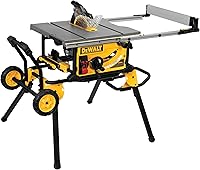
DeWalt DWE7491RS: portable setup with rolling stand
The DeWalt DWE7491RS suits a home woodworker who wants a 10-inch jobsite saw with a rolling stand and a stated 32-1/2-inch rip capacity. Best for a portable setup with wide rip capacity.
Its rack-and-pinion telescoping fence rails retract for storage, and onboard storage holds the fence, guard assembly, riving knife and other included parts. The saw includes a 2-1/2-inch dust collection port for connecting a vacuum.
Consider its 110 lb weight when planning where it will live and how you will move it. The rolling stand is designed to set up and fold down, but it still needs a clear working area and room for long stock.
SKIL TS6307-00: folding stand and blade alignment adjustment
The SKIL TS6307-00 suits a shop that needs a folding stand and a way to micro-adjust blade alignment. It has a 10-inch blade and a stated 25-1/2-inch rip capacity.
Best for compact storage and alignment adjustment.
The saw includes a blade guard, riving knife, anti-kickback pawl, push stick and miter gauge. Its dust port elbow redirects dust toward a container, and the integrated legs fold for storage.
At 51.2 lb, it weighs less than the DeWalt model described above, but confirm that its capacity suits your widest stock. The published 4x4 cutting capacity applies to a 90-degree cut.
SawStop CTS-120A60: compact saw with contact safety system
The SawStop CTS-120A60 may suit a buyer who values a compact footprint and a contact-activated safety system. SawStop says its patented system stops the blade on contact with skin.
Best for a compact saw with a contact safety system.
The saw weighs 79 lb and measures 27 in long by 23.5 in wide by 14.13 in high. Its rack-and-pinion fence is removable and has high and low shelf positions, while the quick-tilt feature and micro-tilt adjustment handle blade angle changes.
The available product facts do not give a rip capacity, so check that measurement for your intended cuts before choosing. The safety system adds protection, but use the guard and safe operating practices as directed in the manual.
Delta 36-6023: stated rip capacity and five-year warranty
The Delta 36-6023 suits a home shop looking for a 10-inch saw with a stated 32.5-inch rip capacity and a stand included. Best for a fixed setup with a five-year professional warranty.
Its rack-and-pinion fence rails are designed for fast adjustments, and the saw includes a carbide blade, miter fence, push stick, rip fence and stand. Delta describes the motor as a 15 amp contractor-grade motor.
The product description also gives a 25-inch rip capacity, which conflicts with the 32.5-inch figure in the title and feature bullets. Confirm the exact capacity with Delta before relying on it for wide panels.
What power and dust setup should you plan?
Check the saw's electrical requirements and the outlet you will use before buying. A motor rating does not replace a check of the shop circuit, and extension cords or shared loads can affect setup.
The options above are corded electric models, and some state a 15 amp rating. Follow the manual's instructions for the correct circuit and cord use, and consult an electrician if the shop wiring is uncertain.
Dust collection can improve cleanup, but the saw's port and your collection system need to match. Check the port size, hose routing and where fine dust may escape before deciding that a particular setup is sufficient.
How do you choose between portable and fixed setups?
Choose a portable saw if you need to store it after work or move it between spaces. Choose a fixed setup if you have room to keep the saw aligned, supported and ready for regular use.
A folding stand or rolling base helps with moving and storage, but it does not make long stock easier to control by itself. Plan outfeed support and a clear path before cutting boards or panels.
For a fixed saw, include the base, dust hose, fence travel and maintenance access in your layout. Measure doorways and turns too, especially if the saw will need to pass through them during delivery.
If portability is the deciding factor, compare the options in our table saws with stands guide. If you are considering a battery model, read whether cordless table saws suit a home shop.
What safety checks belong in your setup?
Use the blade guard, riving knife and anti-kickback parts when the cut allows, and keep hands away from the blade path. Read the manual before setup and operation, and do not make a cut you cannot control safely.
Before cutting, confirm that the blade is installed in the right direction, the workpiece is stable and the fence is set for the cut. Use a push stick when the cut puts your hands near the blade, and stand out of the direct path of possible kickback.
Keep the floor clear and the work area well lit. Disconnect power before changing a blade or making adjustments that could bring your hands near moving parts.
A table saw safety system can add protection, but it does not replace safe setup or careful work. Read our table saw safety features guide before deciding which features matter for your shop.
What should you choose for your home shop?
Choose the saw that covers your regular cuts and fits the room you can actually use. A portable jobsite model suits limited space or changing work areas, while a fixed contractor or hybrid setup suits a dedicated shop.
Compare fence reach and cut depth against your stock, then account for infeed, outfeed and dust collection. If you want a product-by-product shortlist, continue to our best table saws for woodworking.
Frequently asked questions
What kind of table saw is best for woodworking at home?
A jobsite saw is a practical starting point for many home shops because it can fold or roll away when work is done. Choose a larger contractor or hybrid saw if you have a fixed workspace and regularly handle large stock.
Match rip capacity, blade size, power and available room to your actual projects.
Is a 10-inch table saw enough for woodworking?
A 10-inch saw can handle many common home-shop tasks, including ripping boards and cutting sheet goods when its capacity allows. Check the saw's published cut depth, rip capacity and compatible blade options against your projects.
A blade's diameter alone does not tell you how wide a board the fence can support.
How much space do you need for a table saw?
Allow room for the saw, the full length of the workpiece in front and behind the blade, and safe access to the controls. Long boards and sheet goods need additional infeed and outfeed support.
Measure the saw footprint and your working lanes before choosing a permanent spot.
Should a home shop table saw have a riving knife?
A riving knife helps keep the kerf from closing behind the blade, which can reduce the chance of a workpiece pinching the blade and kicking back. Keep it installed when the cut allows, and use the blade guard and anti-kickback parts as directed in the manual.
Read our guide to riving knives and splitters for their differences.
What should I check before buying a woodworking table saw?
Check the saw type, rip capacity, blade size, cut depth, fence adjustment, stand or base, dust collection connection and safety parts. Then confirm that the saw fits your stock, outlet and shop layout.
A precise setup and safe work habits matter as much as the model you choose.