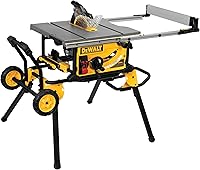
How Much Room Does a Table Saw Need in a Garage Shop?
A table saw needs room for the saw, the full length of the board, and space to stand and move safely. Measure the longest stock you expect to cut, then plan clear infeed and outfeed paths before fixing the saw in place.
On this page (7 sections)
- What do table saw space requirements include?
- How much infeed and outfeed room do you need?
- How much room should you leave around the saw?
- Can a mobile base save garage shop space?
- How do you lay out a table saw in a one-car garage?
- What should you measure before choosing a spot?
- How do you choose a space-saving setup?
A table saw needs room for the saw, the full length of the board, and space to stand and move safely. Measure the longest stock you expect to cut, then plan clear infeed and outfeed paths before fixing the saw in place.
The saw's footprint is only one part of the layout. A garage shop also needs room for the operator, nearby tools, and the things that normally occupy the floor.
What do table saw space requirements include?
Table saw space requirements include the machine, the workpiece path, and the operator's working area. Start by measuring the saw's width and depth, then map the stock from where it enters the blade to where it exits.
A short board needs less travel room than a full sheet of plywood. Don't base your layout only on the saw's dimensions if you plan to cut long boards or large panels.
Mark the saw footprint on the floor with tape. Add the longest workpiece path and stand where you would feed it to see whether a car, bench, cabinet, or garage door blocks movement.
How much infeed and outfeed room do you need?
Leave a clear path long enough for the stock to pass the blade without hitting an obstruction. For a rip cut, check both the feed side and the outfeed side; the board needs to move through the entire cut.
Long boards may need support outside the saw table. Folding roller stands can help support stock and tuck away when they aren't in use.
The WORKPRO stands have edge guides and fold for storage. Place supports so they don't steer the board sideways or interfere with your stance.
The SHALL stands have edge guides and fold for storage. Each stand has a stated capacity of 250 lb, but your layout still needs a clear, controlled feed path.
Neither stand replaces the need to control the workpiece. Check that a board can travel freely and that the support is stable before cutting.
How much room should you leave around the saw?
Keep enough open floor space to stand in a balanced position, guide the material, and reach the controls. The clearance depends on the saw, your position, and the stock you cut.
Avoid placing the saw where you must squeeze between it and a wall while feeding a board. Keep cords, offcuts, clamps, and other trip hazards out of the work area.
Plan access to the blade guard, fence, and power switch. Our table saw safety features guide explains the guard, riving knife, and brake features to consider.
Can the saw sit close to a wall?
A saw can sit near a wall only if the wall doesn't block the board path or prevent you from operating the saw safely. Check the full length of your stock, including space to handle it before and after the cut.
Don't place storage where it can catch the board or force you to twist around the saw. For a compact machine, compare the options in our guide to mini table saws for small projects.
Can a mobile base save garage shop space?
A mobile base can help reclaim floor space when you can roll the saw away between projects. It doesn't reduce the clear space needed while the saw is in use, and the base needs to fit the saw's footprint and weight.
The BORA PM-1100 uses four corner pieces and plywood to make a base sized for your tool. Check that the saw's weight is within its stated capacity before choosing it.
The WEN MB500 has two fixed casters, two swivel casters, and foot-locking brakes. Check the saw's base dimensions before buying.
A mobile base is useful when a car or another tool needs the same floor area. For more help matching the saw to a home shop, see woodworking table saws for a home shop.
How do you lay out a table saw in a one-car garage?
Use the longest stock you expect to cut to choose the saw's position. Mark the machine, infeed path, outfeed path, and operator space on the floor, then check the layout with the garage door and vehicle in place.
If you need to move the saw between uses, plan where it will park and make sure it can roll there without crossing clutter. A mobile base can help with storage, while folding stands can be put away after supporting longer work.
A jobsite saw may suit a garage that needs to change functions. Read our guide to table saws with stands for options built around portable setups.
What should you measure before choosing a spot?
Measure the saw, the longest stock, and the usable garage floor area. Include the open path through the cut, room to stand, and any doors or storage that can intrude.
Before settling on a spot:
- Measure the saw's footprint and base.
- Measure the longest board or panel you plan to cut.
- Map the infeed and outfeed paths.
- Check operator access to controls and the workpiece.
- Test the garage door, car, and storage in their normal positions.
If the path is tight, try the layout with tape and a board before moving heavy equipment. Adjust the saw or storage until you can guide the stock without turning, twisting, or stepping around obstacles.
How do you choose a space-saving setup?
Choose a fixed spot if the saw can stay clear of vehicles and storage; choose a movable setup if it must share floor space. In either case, keep the full workpiece path open whenever you cut.
Pick the BORA base if you want to size a plywood platform around the tool. Pick the WEN base if its adjustable square or rectangular dimensions fit the saw.
For long stock, choose folding supports that can be set near the saw and stored afterward. The WORKPRO and SHALL stands both come as pairs and have adjustable heights.
For more layout decisions, start with the table saw setup and choosing guide. Measure the machine and stock first, then choose the setup that leaves a clear path through each cut.
Frequently asked questions
How much space do you need for a table saw?
Plan for the saw footprint plus clear space in front and behind it for the longest boards you cut, with room to stand beside the work and reach the controls. Measure the stock and your saw's table height, then check the layout with the garage door and storage in their usual positions.
How much room should be behind a table saw?
Leave enough open space behind the saw for the full board to pass through without hitting a wall, vehicle, shelf, or stored material. The needed distance depends on the longest piece you rip, so measure that stock and leave room to guide it.
Can a table saw go in a small garage?
Yes, if you can keep a clear path for the workpiece and stand safely while cutting. A mobile base can let you roll a saw into position and store it afterward, but you still need stable placement and open infeed and outfeed space during use.
Do roller stands replace table saw outfeed space?
Roller stands can support long stock beyond the saw table, but they don't create a safe path by themselves. Set them level with the table, check that the board stays controlled, and keep the area around the blade clear while you feed the work.