Is a Table Saw a Bench Saw?
A bench saw is generally a compact table saw designed to sit on a bench or work surface. The names overlap, but table saws also include jobsite, contractor, hybrid, and cabinet designs.
On this page (9 sections)
- What does bench saw mean?
- Is a table saw a bench saw or a larger tool family?
- How does a bench saw differ from a jobsite table saw?
- Can a bench saw cut sheet goods and hardwood?
- Which compact saw suits a small bench?
- Does the stand change whether a saw is a bench saw?
- How should you set up a bench saw?
- What should you compare before choosing one?
- Is a bench saw right for your woodworking setup?
Yes, a bench saw is usually a compact table saw that sits on a bench or work surface. The phrase “is a table saw a bench saw” causes confusion because table saw describes the broad tool family, while bench saw often describes a smaller setup or portable design.
A table saw uses a circular blade that rises through a flat table. The table supports the workpiece while you guide it past the blade, usually against a rip fence for straight cuts.
A bench saw does the same basic job, but its smaller frame is intended to rest on a bench, stand, or other support.
The useful distinction is not the name alone. Look at the saw’s blade size, rip capacity, stand, table support, storage needs, and the stock you plan to cut.
What does bench saw mean?
A bench saw is a compact table saw made to sit on a workbench, folding stand, or portable support. It normally takes less floor space than a contractor or cabinet saw and suits small shops, garages, and temporary work areas.
The name is used broadly, so two bench saws can have different layouts. One may be a bare saw that needs a sturdy bench.
Another may be a portable jobsite model with folding legs or a rolling stand.
That means “bench saw” is not always a separate technical category. It is often a description of how the tool is supported and moved.
A bench-mounted saw can still have useful table saw features. Rack and pinion fence rails, a riving knife, a miter gauge, onboard storage, and a dust port can all appear on a compact model.
The bench must keep the tool stable, leave room for the fence and material, and support stock as it enters and leaves the blade.
Is a table saw a bench saw or a larger tool family?
A bench saw belongs to the wider table saw family, but not every table saw is a bench saw. Table saws range from small portable units to heavy stationary machines built into dedicated bases.
A simple way to view the categories is:
| Type | Main support | Typical reason to choose it |
|---|---|---|
| Bench saw | Workbench or compact support | Saves floor space |
| Jobsite saw | Folding or rolling stand | Moves between work areas |
| Contractor saw | Freestanding base | Adds mass and work support |
| Hybrid saw | Enclosed or cabinet-style base | Suits a more permanent shop |
| Cabinet saw | Heavy enclosed cabinet | Built for a fixed workshop |
These labels overlap in everyday speech. A portable jobsite saw may also be called a bench saw when someone uses it on a workbench.
For a small room, a compact bench-style saw keeps the floor clear. For repeated work on long boards, a stand or outfeed surface is more helpful than the smallest possible footprint.
How does a bench saw differ from a jobsite table saw?
A bench saw depends more on the support beneath it, while a jobsite saw usually includes a stand or folding frame. Both can be portable, but the setup time and material support can feel different.
A jobsite saw often gives you legs, a work height, or wheels as part of the design. That makes it easier to use where no suitable bench is nearby.
A bench-style unit can be lighter and easier to store on a shelf. You still need a stable surface at the right height, plus enough space for the fence, miter gauge, and workpiece.
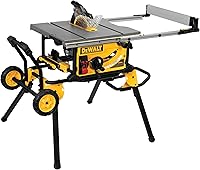
The DeWalt DWE7491RS 10-Inch With Rolling Stand takes the jobsite approach. It includes a rolling stand designed for setup and breakdown, telescoping fence rails, a 32-1/2 in rip capacity, and a 15 amp motor.
Its onboard storage holds the blade guard assembly, fence, riving knife, miter gauge, wrenches, push stick, and cord wrap. The 2-1/2 in dust collection port connects to a vacuum.
Can a bench saw cut sheet goods and hardwood?
Yes, a bench saw can cut sheet goods and hardwood, but capacity and support decide how practical the work will be. The blade diameter and rip capacity tell you how much material the saw can handle, while the surrounding workspace controls how safely you can guide it.
A 10 in jobsite saw offers more blade depth than a smaller compact model. The DWE7491RS has a 32-1/2 in rip capacity and a 3-1/8 in depth of cut at 90 degrees.
Its table measures 21-7/8 in by 26-3/8 in, and the stand brings the work surface to a usable height.
The SKIL TS6307-00 10-Inch Jobsite Saw offers a 25-1/2 in rip capacity and a 4x4 cutting capacity at 90 degrees. Its integrated folding legs turn into a folding stand.
Both models use rack and pinion fence systems. The SKIL also includes parallel blade alignment, a dust port elbow, and a 0 to 45 degree bevel range with positive stops at 0 and 45 degrees.
Long plywood or shelving panels still need support beyond the table. A saw can have enough rip capacity on paper and remain difficult to control if the sheet drops or twists during the cut.
Which compact saw suits a small bench?
The DeWalt DWE7485 8-1/4 Inch Compact Saw suits a small bench when storage space matters more than a full-size blade. Its compact body is easier to place in a crowded shop, and its 24.5 in rip capacity covers many 4x8 plywood or OSB ripping tasks.
The DWE7485 has rack and pinion telescoping fence rails, a metal roll cage base, and onboard storage for the guard, fence, wrenches, and miter gauge. Its Site-Pro Modular Guarding System allows tool-free guarding adjustments.
The saw weighs 54 lb and measures 22.75 by 22.75 by 13 in. Those dimensions make it easier to store than a saw with a permanent stand, but your bench must supply working height and surrounding support.
Its 15 amp motor runs at 5800 rpm, and the included blade is an 8-1/4 in 24T blade. The power-loss reset prevents an accidental restart after a power disruption.
Pick this compact model when the saw must live on a bench or shelf. Pick a 10 in jobsite design when deeper cuts, a larger table, or an integrated stand matter more.
Does the stand change whether a saw is a bench saw?
Yes, the stand changes the setup even when the saw itself is compact. A folding or rolling stand turns a portable saw into a freestanding workstation, while a bench-mounted saw leaves the support and work height to you.
The SKIL TS6307-00 has integrated folding legs. That makes it self-supporting when open, then more compact when stored.
The DWE7491RS has a rolling stand designed for easy setup and breakdown. Its telescoping fence rails retract to form a smaller portable package, and its flip-over ripping fence supports narrow rip cuts.
A stand also changes how you handle long stock. The saw remains responsible for the cut, but the stand gives you a starting point for arranging infeed and outfeed support.
A separate table saw roller stand can help when boards extend past the saw table. Place support so it keeps the stock level without pushing it upward, sideways, or into the fence.
How should you set up a bench saw?
Set the saw on a stable, level surface with clear space on every side of the cut. The bench should not rock, shift, or force you to twist around the workpiece.
Start with the blade and fence aligned. The saw needs a straight path from the infeed area through the blade and outfeed area.
Before making a cut, learn how to align a table saw so the fence, blade, and miter slot work together.
Plan where cut pieces will go after the blade. A roller stand, outfeed table, or clear bench can prevent a long board from dropping as it leaves the saw.
Use the supplied blade guard, riving knife, anti-kickback parts, push stick, and miter gauge as the cut requires. The DWE7491RS includes these parts, and the SKIL includes a blade guard, push stick, miter gauge, anti-kickback pawl, riving knife, and 24T blade.
What should you compare before choosing one?
Compare the support system first, then compare blade size and rip capacity. The right choice is the saw that fits your work area without leaving long stock unsupported.
For a small bench, the DWE7485 offers the smallest listed dimensions of these 3 products and weighs 54 lb. Its 8-1/4 in blade and 24.5 in rip capacity make it a compact choice for common sheet-good work.
For a folding freestanding setup, the SKIL TS6307-00 weighs 51.2 lb and includes integrated folding legs. Its 10 in blade, 25-1/2 in rip capacity, 4x4 cutting capacity, and 0 to 45 degree bevel range cover portable tasks.
For the largest rip capacity and a rolling stand, the DWE7491RS weighs 110 lb and provides 32-1/2 in of rip capacity. Its 10 in blade, 15 amp motor, telescoping fence rails, and onboard storage favor a portable workstation with more material room.
If you are still comparing layouts, our guide to how to buy a table saw organizes the decision around capacity, portability, support, and shop space.
Is a bench saw right for your woodworking setup?
Choose a bench saw when saving floor space is the main goal and you have a strong surface ready for it. Choose a jobsite table saw when you need the tool to stand on its own, fold for storage, or move between work areas.
The DWE7485 is the clearest compact bench choice here. The SKIL TS6307-00 is the better fit for a folding freestanding setup, while the DWE7491RS is the strongest overall pick when you want the highest rip capacity and a rolling stand.
So, is a table saw a bench saw? Sometimes, when the table saw is a compact model used on a bench.
The name matters less than the support, cutting capacity, and space around the blade. For a broader look at shop layouts, see this guide to a woodworking table saw.
Frequently asked questions
Can a bench saw cut the same wood as a table saw?
A bench saw can rip and crosscut wood like other table saws, but its table size, rip capacity, blade size, and support setup determine what it handles comfortably. Large sheet goods and long boards need more outfeed and side support than small bench work.
Is a jobsite table saw better than a bench saw?
A jobsite table saw is better when you need a built-in stand, wheels, or more support around the blade. A bench saw suits a permanent workbench setup where compact storage matters more than a freestanding frame.
What size table saw is best for a small shop?
An 8-1/4-inch compact saw saves space, while a 10-inch jobsite saw gives you a larger blade and more cutting room. Choose based on the material you cut, the space around the saw, and whether you need a folding or rolling stand.
Do bench saws need an outfeed table?
They need safe support whenever a board extends beyond the rear of the table. A separate outfeed table, roller stand, or workbench can keep long stock level as it leaves the blade, provided the support does not interfere with the cut.