How to Buy a Table Saw
To buy a table saw, start with the work you actually do, then match three numbers to it: rip capacity, depth of cut and motor size. Pick the saw class that fits your shop and how often you move it, then judge the fence, stand and safety features.
On this page (9 sections)
- How big a table saw do I need for my projects?
- Which type of table saw should you buy?
- How do you judge a table saw's motor and fence?
- What rip capacity and table size fit your shop?
- Which safety features should you insist on?
- How should you set up and maintain a new table saw?
- What should you budget for beyond the saw itself?
- Common mistakes when buying a table saw
- The final rule for buying a table saw
Knowing how to buy a table saw comes down to one thing: the saw has to fit the work you do and the space you do it in. Match the saw's size, power and fence to your cutting list first, and the brand choices get much simpler.
Most buyers start with a budget and then hunt for a saw. That order is backward, because the wrong class of saw will frustrate you no matter what it costs.
The steps below walk through the decisions in the order that matters.
A table saw is a serious tool, so it's worth knowing is a table saw a power tool and what that means for your shop setup. With that clear, start with the size and power question.
How big a table saw do I need for my projects?
Start with the widest and thickest material you expect to cut. Rip capacity sets how wide a board you can slice, and depth of cut sets how thick a board you can go through.
A 10-inch saw is the common home-shop size. The DeWalt DWE7491RS, for example, cuts 3-1/8 inches deep at 90 degrees and 2-1/4 inches at 45 degrees.
That covers most framing lumber, shelving and trim.
Its 32-1/2 inch rip capacity means you can slice wide shelving and sheet goods down to size without reaching for a track saw. That number matters more than the blade size for anyone cutting plywood or wide boards.
How to size rip capacity to your material
Measure the widest thing you buy. A 32-1/2 inch capacity handles the second pass after you break 4x8 sheets down with a circular saw.
Narrower portable saws, around 20 to 24 inches of rip capacity, suit trim work and small stock.
Pick a saw with capacity past your widest board, not one that only just reaches it. The extra inches give you room for the fence and blade kerf and keep your cuts straight.
Depth of cut and blade size
A 10-inch blade gives you about 3 inches of depth in softwood. That's enough for 2x lumber, which is 1-1/2 inches thick.
Hardwood takes more motor effort, so the motor matters too.
An 8-inch blade saw cuts less deep, but its smaller blade and lighter frame suit tight shops. It's the wrong choice for thick stock or repeated hardwood ripping.
Write down your thickest planned cut before you shop. Under 2 inches, a compact saw can do the work.
Over 3 inches, you need a 10-inch blade and the power to spin it.
Which type of table saw should you buy?
Choose the saw class by where the saw will live and how often it moves. Portable jobsite saws suit tight shops and moving between sites, while contractor and cabinet saws suit a fixed bench with more room.
Jobsite saws fold down onto a rolling stand and store against a wall. Contractor saws sit on an open frame with the motor hanging behind, and cabinet saws enclose the motor in a full cabinet for stability.
Most home woodworkers land on a jobsite or contractor saw.
Jobsite saws for small shops and moving work
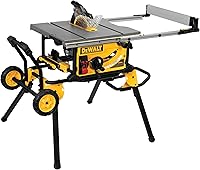
A jobsite saw weighs less than a cabinet saw and often includes a folding stand. The DeWalt DWE7491RS is a 10-inch jobsite saw at 110 pounds, and its rolling stand folds for storage or transport.
These saws trade some table stability for portability. A light frame can flex under a heavy board, so technique and outfeed support matter more.
The upside is that the saw packs away in minutes.
Pick a jobsite saw if your shop shares space with a car, if the saw travels to jobs, or if you want to store the saw between projects rather than build a bench around it.
Contractor and cabinet saws for a fixed shop
A contractor saw stays put and gives you a larger, steadier table. Cabinet saws go further with an enclosed base and more mass, which helps with long, heavy cuts.
Both ask for a dedicated footprint.
Moving a contractor or cabinet saw between jobs is not practical for one person. Pick a fixed saw when your projects are regular and your shop has the floor space.
Pick a portable saw when the saw must come out and go away on the same day.
How do you judge a table saw's motor and fence?
The motor and the fence separate a saw that works smoothly from one that fights you. A fence that locks square and adjusts without fiddling matters more than a motor's raw horsepower for most home cutting.
A 15 amp motor on a 10-inch saw handles hardwoods and repeated ripping. The DeWalt DWE7491RS uses a 15 amp motor at 4800 rpm.
That's enough for home projects without tripping a typical 15 or 20 amp household circuit.
Look at how the fence moves. A rack and pinion system adjusts smoothly and holds its position.
DeWalt uses this system on the DWE7491RS so fence changes stay fast and accurate.
Fence types and what to check in the store
Rack and pinion fences move the fence with a gear rather than a slide. They adjust in small steps and hold the setting well.
A cheaper fence may drift when you lean on it, which pushes your cut off square.
Check the fence lock and the rail alignment before you buy. A fence that clamps square at one width and skews at another causes binding.
Ask to move the fence across its full range if the store allows it.
Motor size, power source and run time
A corded saw runs all day without a battery. The DWE7491RS is corded electric with a 15 amp motor.
That's the practical choice for long sessions and hard material. Cordless saws suit light trim work and quick cuts away from an outlet.
For thick stock and repeated rips, corded power stays the safer bet.
After you set up the saw, the fence and blade need to line up. Our guide on how to align a table saw walks through squaring the blade to the miter slot and the fence to the blade.
What rip capacity and table size fit your shop?
Measure your shop's free floor space and your widest material together. A saw's rip capacity and table size decide what you can cut in one pass, while its footprint decides whether it fits.
The DeWalt DWE7491RS has a 21-7/8 x 26-3/8 inch table. That's a compact top for a jobsite saw, and its telescoping rails extend when you need more support.
Small tables suit short boards. Long stock needs outfeed support so the board doesn't tip after the blade.
Working with sheet goods and long boards
Ripping a 4x8 sheet on a compact saw takes planning. Break the sheet down with a circular saw first, then finish the narrower pieces on the table saw.
The 32-1/2 inch capacity on the DWE7491RS covers most shelf and trim widths.
For long boards, line up support behind and beside the saw. A roller stand holds the back end level as the board leaves the blade.
Our roundup of the best roller stands for table saw outfeed support compares options that match this saw's height.
Set the stand height to match the saw table so the board slides flat. A stand a little too high or low catches the board edge and throws your cut off.
Footprint, storage and clearance
A portable saw folds down and rolls into a corner. The DWE7491RS includes an onboard storage system for the blade guard, fence, miter gauge, wrenches and push stick.
That keeps the accessories with the saw instead of lost in a drawer.
Leave clear space on the infeed and outfeed sides for the board to travel. A saw against a wall works for crosscuts but fights you on long rips.
Check the doorway width if the saw rolls between rooms. The DWE7491RS weighs 110 pounds on its stand, so a level path makes moving it practical.
Which safety features should you insist on?
Buy a saw with a blade guard and a push stick, and use both. A blade guard shields the teeth above the table and reduces kickback risk when the cut wood binds, and it's the feature to check first.
The DeWalt DWE7491RS includes a blade guard assembly and a push stick. DeWalt lists tool-free guarding component adjustments, so the guard comes off and on without hunting for a wrench.
A guard and splitter reduce the risk of the blade catching the wood and throwing it back at you.
Push sticks and blade guards
A push stick keeps your hands away from the blade on narrow rips. The DWE7491RS ships with one, and you should keep it near the saw rather than in a toolbox.
The blade guard covers the blade above the table. Some cuts need it off, but you should fit it back for routine rips.
The guard only comes out for special work. Check that it adjusts without tools, because fiddly guards get left off.
Featherboards and other hold-downs
A featherboard presses the stock against the fence and reduces chatter. The Hedgehog Spiral Featherboard fits standard 3/4 inch by 3/8 inch miter slots.
Measure your slot before you buy, since 5/8 inch slots need a different fit.
Its single knob lets you set it one-handed and get back to cutting. Traditional featherboards need two knobs loosened and retightened each time.
The spiral design also reduces drag compared with foam versions. Our roundup of the best table saw featherboards compares more hold-down options.
How should you set up and maintain a new table saw?
Set up the saw before the first cut. Square the blade to the miter slot and the fence to the blade, then check the blade height and the dust collection.
The DWE7491RS includes a 10-inch 24-tooth carbide blade, a miter gauge, two blade wrenches and the guard assembly. That's enough to start cutting as soon as the saw is assembled and aligned.
Dust collection matters more than many buyers expect. The DWE7491RS has a 2-1/2 inch dust collection port that connects to a vacuum.
Aligning the blade, fence and miter slot
Check the blade against the miter slot with a square or a dial indicator. A blade out of square binds on long rips and burns the wood.
Adjust the trunnions until the blade sits parallel to the slot.
Then set the fence parallel to the blade. A fence that drifts toward the blade at the back pinches the wood and causes kickback.
Our how to align a table saw guide covers the full sequence. Recheck alignment after moving the saw, since a portable saw on a rolling stand can shift as it rolls.
Blade height, dust collection and routine care
Set the blade just above the stock, about a tooth's height above the wood. A blade set too high throws more dust and exposes more of the teeth.
A blade set too low adds friction and burning.
Connect the dust port to a vacuum or a dust collector. Empty the vacuum often during long sessions so airflow stays strong.
Clean the table and the fence rails now and then. Sawdust on the table makes boards drag and pushes cuts off line.
What should you budget for beyond the saw itself?
Budget for the saw first, then add the accessories your work needs. A featherboard, outfeed support and good blades cost extra, and they change how well the saw performs.
The DeWalt DWE7491RS comes with a blade, guard, miter gauge and push stick. Many saws do, so you can start cutting without buying extras.
The accessories add safety and precision as your projects grow. A spare blade for fine cuts is the first upgrade for most buyers.
A 24-tooth blade rips fast but leaves a rougher edge. A higher-tooth blade smooths crosscuts and trim.
Accessories that earn their place
A featherboard is the cheapest safety upgrade after the push stick. The Hedgehog fits a 3/4 inch miter slot and holds stock against the fence.
Add one if your saw lacks a hold-down.
Outfeed support comes next for long boards. A folding roller stand adjusts from 27 to 43 inches and holds up to 250 pounds.
That range covers most table saw heights. A good push stick, eye protection and hearing protection round out the kit.
These are small costs next to the saw, so don't skip them.
Budget tiers and what they buy
A budget portable saw covers trim and small stock. It may skip the rolling stand or come with a simpler fence.
Expect to add a stand and a featherboard.
A mid-range jobsite saw like the DWE7491RS adds a rolling stand, a rack and pinion fence and onboard storage. That's the sweet spot for a home shop that needs to pack away.
Premium contractor and cabinet saws cost more and stay put. Pick that tier only when your shop has room for a fixed saw.
Common mistakes when buying a table saw
Buying on price alone is the most common mistake. A cheap fence or a weak stand costs you time and safety on every cut, so judge the saw as a system.
The next mistake is ignoring the space. A big saw in a small shop blocks your walkway and gets in the way of long boards.
Measure the floor and the doorways first.
Another mistake is skipping accessories. A saw without a blade guard or push stick asks you to buy them later.
Check what's in the box before you compare prices. Finally, don't forget the outlet.
A 15 amp saw needs a circuit that can carry it.
The final rule for buying a table saw
The short answer to how to buy a table saw is this: match the saw's rip capacity, depth of cut and motor to your widest and thickest material, then pick the class by where it lives. If it moves, choose a jobsite saw with a folding stand.
If it stays, choose a contractor or cabinet saw with more table and weight.
For most home shops that need to pack away, the DeWalt DWE7491RS is the pick. It brings a 15 amp motor, a 32-1/2 inch rip capacity, a rack and pinion fence and a rolling stand in one package.
Add a featherboard and outfeed support as your projects grow.
Before you buy, check the fence for square movement and confirm the box includes the blade guard and push stick. Then set up the saw and align it.
A square blade and fence turn a mid-range saw into a precise one.
Frequently asked questions
How much rip capacity do I need on a table saw?
Plan on a rip capacity a little wider than the widest board you expect to cut. A 32-1/2 inch capacity handles most shelving and trim, while smaller portable saws limit you to narrower stock.
Measure the widest material you buy before you decide.
Is a 10-inch table saw big enough for most woodworking?
A 10-inch saw covers most home woodworking needs. The DeWalt DWE7491RS cuts 3-1/8 inches deep at 90 degrees and 2-1/4 inches at 45 degrees, which handles common lumber.
Thicker or unusual stock needs a bigger blade or a different tool.
Should I buy a jobsite saw or a contractor saw?
A jobsite saw fits when you move it between rooms or job sites, since its light frame and stand fold away. A contractor or cabinet saw suits a fixed shop where stability and a heavier table matter more.
Choose by where the saw will live.
Do I need a rolling stand with a portable table saw?
A rolling stand saves your back if the saw leaves its spot often. The DeWalt DWE7491RS includes one with wheels and a folding frame.
For a fixed bench, a stand matters less than a stable base and room to feed long boards.
What safety gear should I budget for with a table saw?
Plan for a push stick and a blade guard, both of which the DeWalt DWE7491RS includes. A featherboard such as the Hedgehog Spiral holds stock against the fence and lowers kickback risk.
Add eye protection and hearing protection too.
How do I choose a table saw fence?
A rack and pinion fence adjusts smoothly and holds its setting, which matters more than raw size. The DeWalt DWE7491RS uses this system, and a fence that drifts means repeated measuring.
Check the fence locks square before you buy.