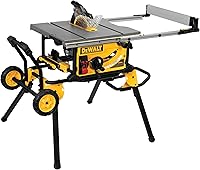
How Much Are Table Saws?
Table saws range from budget jobsite tools to higher-cost saws with stands and larger rip capacity. The right budget depends on portability, cutting room, fence control, dust collection, and the work you plan to do.
On this page (9 sections)
- What makes table saws cost more?
- What should a home shop budget cover?
- Is a budget jobsite table saw enough?
- Is a rolling stand worth the added cost?
- Does a higher-cost portable saw add useful features?
- How much power does a table saw need?
- Which table saw features matter more than cost?
- How do you compare table saw cost with shop space?
- What should you pick for the money?
How much are table saws? They cost more as you add a stronger work platform, greater rip capacity, better fence control, dust handling, and a more useful stand.
For many home shops, a 10-inch portable saw with a 15-amp motor is the practical starting point.
The purchase price is only part of the decision. A folding saw may suit a shared garage better than one that stays set up, while a wider fence system helps with shelving and sheet goods.
What makes table saws cost more?
The main cost drivers are format, rip capacity, stand, fence system, motor, and included safety parts. A compact saw saves space, while a larger portable setup offers more support and easier movement.
All three saws here use 10-inch blades and 15-amp motors, but they differ in speed, stand design, fence adjustment, braking, and support features. Rip capacity affects the width of material you can size without extra support.
The SKIL reaches 25-1/2 inches, while the DeWalt reaches 32-1/2 inches and the Bosch reaches 32-1/8 inches. Folding legs reduce storage trouble, while wheeled stands help when a saw moves around the shop.
What should a home shop budget cover?
A useful table saw budget should include the saw, stand, dust connection, safe work area, and suitable blades. The tool is only part of the setup if you have nowhere to support long boards or move safely around the table.
Plan space around the material, not only around the stored dimensions. You need room to feed stock into the blade, guide the cut past the fence, and collect the finished piece.
Review the table saw space requirements before choosing a model for a garage. A folding stand can reduce storage space, but cutting full boards still requires clear floor space.
Dust collection also affects usefulness. The DeWalt has a 2-1/2-inch dust collection port, while the SKIL includes a dust port elbow.
Each saw includes a blade, with the DeWalt and SKIL listing 24-tooth blades and the Bosch listing a 50-tooth count.
Is a budget jobsite table saw enough?
A budget jobsite saw is enough for many DIY projects when you need portability, basic ripping, and a folding setup. Look for a stable table, smooth fence adjustment, a useful bevel range, and a stand that matches your storage space.
The SKIL TS6307-00 is the lightest option here at 51.2 lb. Its integrated legs fold for storage, and its 25-1/2-inch rip capacity covers many boards and smaller panels.
It also has rack-and-pinion fence rails, parallel blade alignment, a 0–45° bevel range, and 4x4 cutting capacity at 90 degrees. Those features fit a homeowner working on framing, shelving, trim, and general shop projects.
The trade-off is working width. Its rip capacity is smaller than the DeWalt and Bosch, so it gives less room for wide sheet goods.
Who suits the SKIL TS6307-00?
Choose the SKIL TS6307-00 10-Inch Jobsite Saw when easy storage and lighter movement matter most. Its folding stand, 51.2 lb weight, rack-and-pinion fence rails, and parallel blade alignment suit a shared garage or mobile work area.
Its dust port elbow redirects dust toward a container. Included parts include a blade guard, push stick, miter gauge, anti-kickback pawl, riving knife, rip fence, wrenches, and 24-tooth blade.
Is a rolling stand worth the added cost?
A rolling stand is worth choosing when setup, breakdown, and movement are part of your normal work routine. It can reduce repositioning effort when the tool moves between storage and the cutting area.
The DeWalt DWE7491RS includes a rolling stand designed for setup and breakdown. Its telescoping fence rails retract to make a smaller portable package, and its flip-over ripping fence supports narrow rip cuts.
This model offers 32-1/2 inches of rip capacity for larger shelving and trim materials. Its rack-and-pinion telescoping fence is designed for fast adjustments, and its 15-amp motor runs at 4800 rpm.
The saw weighs 110 lb, so the rolling stand is especially useful. It also has a 2-1/2-inch dust collection port for vacuum connection.
Who suits the DeWalt DWE7491RS?
Pick the DeWalt DWE7491RS 10-Inch With Rolling Stand for a home shop that needs wide rip capacity and a portable setup with wheels. It suits shelving, trim, sheet material, and repeated moves between storage and work.
The included parts cover the rolling stand, push stick, miter gauge, rip fence, blade wrenches, blade guard assembly, and 10-inch 24-tooth carbide blade. The 21-7/8 x 26-3/8-inch table gives material support during cuts.
Does a higher-cost portable saw add useful features?
A higher-cost portable saw earns its place when its stand, fence, braking, motor control, and safety system solve problems you face often. The Bosch GTS15-10 focuses on a wheeled stand, controlled adjustments, and repeated jobsite use.
The Bosch uses a 15-amp motor with electronically regulated speed and a 3800 rpm speed. Its rack-and-pinion rip fence uses color-coded index pins and a hand dial for adjustments.
Its Rise wheeled stand has 8-inch treaded rubber-composite tires and a foot release pedal. The stand supports single-action setup and take down, which suits readers who move the saw regularly.
The Smart Guard System includes a three-position adjustable riving knife, anti-kickback pawls, and a barrier guard assembly. The saw also has a brake and soft-start circuitry.
Who suits the Bosch GTS15-10?
The Bosch GTS15-10 10-Inch With Rise Stand fits a mobile workshop that values a wheeled setup, 32-1/8-inch rip capacity, controlled fence adjustments, and its Smart Guard System. Its 103 lb weight makes the stand central to moving it.
It provides 4x4 single-cut capacity and on-tool storage for the rip fence, miter gauge, Smart Guard System, hex wrench, blade wrench, and push stick. Its 10-inch blade data identifies a 50-tooth count.
How much power does a table saw need?
A 15-amp motor is the common power level in these portable choices, and it suits many home-shop ripping and cross-cutting tasks. Power alone does not decide the best saw because fence control, support, speed control, and material also affect the result.
The DeWalt, SKIL, and Bosch each use a 15-amp motor. The DeWalt is rated at 4800 rpm, the Bosch at 3800 rpm, and the SKIL product data identifies its current rating as 15 A.
The Bosch adds electronically regulated speed to help maintain speed under load. The DeWalt emphasizes hardwood ripping and has the largest rip capacity, while the SKIL combines its motor with a 4x4 cutting capacity.
For more on motor size and shop needs, read table saw horsepower. Use your circuit, material size, and work pattern as the deciding factors rather than amperage alone.
Which table saw features matter more than cost?
Fence movement, material support, safety equipment, storage, and dust control often matter more than a small difference in motor speed. These features affect setup time and how comfortably you guide material through a cut.
A rack-and-pinion fence appears on all three choices. The DeWalt uses a telescoping fence and flip-over ripping fence, the SKIL uses rack-and-pinion rails with parallel blade alignment, and the Bosch uses color-coded index pins with a hand dial.
Material support matters when pieces get wide or long. The DeWalt includes patented material support for narrow rip cuts and a 32-1/2-inch capacity.
The Bosch reaches 32-1/8 inches, while the SKIL reaches 25-1/2 inches.
Safety parts differ in presentation. The SKIL includes an anti-kickback pawl and riving knife, while the Bosch groups a riving knife, anti-kickback pawls, and barrier guard assembly into its Smart Guard System.
How do you compare table saw cost with shop space?
Choose the saw that fits both your stored space and your working space. The smallest folded tool is not automatically easiest to use if you cannot feed material safely or support the workpiece.
The SKIL weighs 51.2 lb and has integrated folding legs, making it simplest to move by hand. Its listed dimensions are 28.74 x 27.17 x 16.93 inches.
The Bosch weighs 103 lb and measures 28.1 x 27.8 x 13.53 inches, while the DeWalt weighs 110 lb and measures 31 x 24 x 28.52 inches. Their stands and wheels make movement more practical than hand carrying.
Measure doorways, storage shelves, and the clear path to your cutting area. Leave enough room for the longest material you expect to cut.
What should you pick for the money?
For most readers, the DeWalt DWE7491RS is the strongest overall choice because it combines a rolling stand, 32-1/2-inch rip capacity, fence adjustment, narrow-rip support, and dust collection. Choose the SKIL when lighter storage matters more, or the Bosch when its Rise stand and Smart Guard features fit your work.
The SKIL is the sensible compact option for a shared garage, occasional DIY work, and projects within its 25-1/2-inch rip capacity. Its folding legs and lighter weight keep storage simple.
The Bosch suits a mobile work area that values a wheeled stand, 32-1/8-inch capacity, electronically regulated speed, and Smart Guard System. Its weight makes the stand important for moving it.
If you're still deciding how much are table saws worth for your projects, start with material width, storage, and movement needs. Then use how to buy a table saw and how to align a table saw to finish the choice and plan the first setup.
Frequently asked questions
Is a 10-inch table saw enough for home woodworking?
Yes, a 10-inch table saw handles common home-shop work such as ripping boards, sizing shelving, and cutting trim. The motor, rip capacity, fence, stand, and available workspace matter as much as blade diameter, so match those features to your projects.
Does a table saw need a stand?
A stand helps when you need to move, set up, or store a portable saw. A folding or wheeled stand adds convenience, while a fixed shop base favors a permanent workspace; choose based on how often the saw changes location.
How much rip capacity do I need?
Choose rip capacity by the widest material you expect to cut. Around 25 inches suits many boards and panels, while about 32 inches gives more room for shelving, trim, and wider sheet goods.
Are portable table saws good for a garage shop?
Yes, portable table saws suit garage shops when you need to fold or roll the tool away. Measure the stored footprint, working clearance, and path through the garage before choosing a stand or saw.