Evolution R10TBLX Table Saw Review: Worth It? (October 2026)
The Evolution R10TBLX fits a portable shop that needs a wheeled stand and dado capability. Its 26-inch rip capacity suits many common cuts, while its corded motor and rolling stand shape where and how you can use it.
On this page (10 sections)
- What comes with the Evolution R10TBLX?
- How does the R10TBLX compare with the R10TS?
- Is 26 inches of rip capacity enough?
- What do the dado and zero-clearance plates do?
- How much room does the wheeled stand need?
- What safety features does the R10TBLX include?
- How should you set up the R10TBLX?
- What common mistakes should you avoid?
- Which jobsite saw fits your priorities?
- Is the Evolution R10TBLX right for your shop?
The Evolution R10TBLX is a 10-inch jobsite table saw with a wheeled folding stand, 26-inch rip capacity and included dado plate. This Evolution R10TBLX review focuses on whether those features fit your shop, workpieces and storage needs.
The clearest reason to choose it is its included rolling stand and woodworking accessories. It is a practical match for a corded portable setup, but its capacity and footprint may not suit every shop.
What comes with the Evolution R10TBLX?
The R10TBLX combines portable handling with accessories for repeatable woodworking cuts. It has a rack and pinion fence, zero-clearance throat plate, cross-cut sled and dado plate.
Evolution R10TBLX 10-Inch With Wheeled Stand: Best for rolling jobsite setup
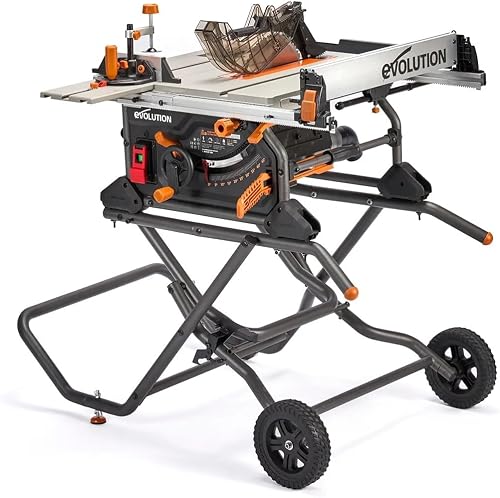
- 15A corded motor
- 26 in rip capacity
- 3-3/8 in maximum cut depth
- Wheeled folding stand
- Dado plate included
A portable 10-inch saw with a folding wheeled stand, dado plate, zero-clearance throat plate and cross-cut sled. Its corded motor needs an outlet at the work area.
Pros
- Wheeled folding stand and carry handles
- Dado plate and zero-clearance throat plate included
- Rack and pinion fence
- Electronic blade brake, anti-kickback pawls and riving knife
Cons
- Requires corded power
- 26 in rip capacity may be limiting for wider panels
- Wheeled stand still needs storage and setup space
Its 10-inch TCT blade works with a 0–45° bevel range and geared bevel adjustment. The maximum cut depth is 3-3/8 inches, and the rip capacity is 26 inches.
The collapsible stand has all-terrain wheels, carry handles and a quick-fold system. An outfeed support bar helps with larger materials, while onboard storage keeps small accessories with the saw between jobs.
Who should buy the Evolution R10TBLX?
Buy the R10TBLX if you need to move a corded saw between work areas and want the wheeled stand included. It also makes sense if dado and groove work is part of your plan and you value having the plate included.
Skip it if your work regularly requires ripping panels wider than 26 inches, or if you need a saw where corded power is unavailable. The stand folds, but it still needs a storage space and room to open.
Before deciding, measure the storage spot, the open footprint and the material path through the saw. Include space for infeed and outfeed support, not just the saw's dimensions.
How does the R10TBLX compare with the R10TS?
The R10TBLX and R10TS share the same stated 26-inch rip capacity, 3-3/8-inch maximum cut depth, dado plate and core cutting accessories. The main practical difference is that the R10TBLX includes a wheeled stand.
The R10TS includes a blade, but its included components do not name a stand. Choose it if you already have a suitable support or want to select one separately, then compare the models in our Evolution R10TBLX vs R10TS comparison.
Both saws are corded and have a 0–45° bevel range. Check the exact included parts and manual for the model you choose, especially if stand compatibility or dado setup will affect your work.
Is 26 inches of rip capacity enough?
A 26-inch rip capacity is enough for many common cuts, but your widest regular workpiece should decide the question. Measure the material you expect to cut and check whether the fence can reach the required width.
Rip capacity describes the distance available between the blade and fence. It does not support a long panel by itself, so plan stable help at the infeed and outfeed ends before making a cut.
The Delta 36-6023 has a stated 32.5-inch rip capacity, which may suit wider stock. Our table saw rip capacity guide explains how to match capacity to your work and support setup.
What do the dado and zero-clearance plates do?
The included dado plate supports dado and groove work, while the zero-clearance throat plate is designed for cuts close to the blade with reduced tear-out. These accessories give the saw more options for joinery and cleaner edges.
A dado setup depends on compatible blades, correct installation and the saw's permitted configuration. Consult the manual for blade size, adjustment and safety parts before making a groove cut.
A zero-clearance plate is intended for a specific blade and cut setup. Read our guide to table saw zero-clearance inserts to understand how these plates fit and when they help.
How much room does the wheeled stand need?
The folding wheeled stand helps you move and store the saw between jobs, but a safe working setup needs room around it. The saw measures 29 x 29 x 15 inches; allow for the open stand and the length of stock you need to feed.
Measure the full working area with the stand open. Keep a clear route for material and room for outfeed support, particularly when handling larger boards or panels.
For a garage shop, mark the footprint and material path on the floor before settling on a location. Our guide to table saw space in a garage shop covers the clearances and work paths to consider.
What safety features does the R10TBLX include?
The R10TBLX includes an electronic blade brake, anti-kickback pawls and a riving knife. Those features support safe operation, but setup, work support and following the manual still matter.
Install and adjust the guard and safety parts as directed before use. Keep hands clear of the blade path and use a push stick or other safe method when the cut requires it.
Our table saw safety features guide explains the roles of guards, riving knives and brakes. Keep safety parts in place and do not bypass them to make a cut.
How should you set up the R10TBLX?
Set up the R10TBLX on a stable, level surface with enough clearance to handle your workpiece. Lock and check the stand according to the manual, then make sure the saw and stock have adequate infeed and outfeed support.
Before the first cut, confirm the fence is secure and aligned for the work, the blade and throat plate are correctly installed, and the bevel is set to the intended angle. Use the manual for blade changes and dado configuration rather than relying on a general setup description.
Plan dust collection and cord routing before starting. Keep the cord away from the blade, moving stock and walking path, and clear offcuts only after the blade has stopped.
What common mistakes should you avoid?
The most common buying mistake is choosing by the stand alone and overlooking the cut width, power source and room needed to work. Check those limits against your actual projects before committing to a portable saw.
Do not assume the included dado plate means every dado blade or setup is suitable. Confirm the allowed configuration in the manual, and do not remove the safety parts unless the manual specifies a safe configuration for that operation.
A second mistake is treating rip capacity as a substitute for material support. Set up stable support for long stock, and do not begin a cut if the workpiece cannot be guided and supported safely.
Which jobsite saw fits your priorities?
Choose the R10TBLX for rolling storage and included dado capability. The SKIL TS6307-00 is a close alternative if integrated folding legs, blade alignment adjustment and a dust port elbow matter more to you.
The SKIL has a 25-1/2-inch rip capacity, close to the R10TBLX's 26 inches. It also lists parallel blade alignment micro-adjustment, a 4x4 cutting capacity at 90 degrees and a folding stand.
Choose the Delta 36-6023 if wider cuts are a regular need. Its stated 32.5-inch rip capacity and stacked dado capacity favor larger stock, while the R10TBLX has the clearer advantage when an included wheeled stand is central to your setup.
For a broader look at portable saw features, visit our jobsite table saw guide. Compare the tools against your typical stock, storage, power and support needs.
Is the Evolution R10TBLX right for your shop?
Pick the Evolution R10TBLX if you want a corded portable saw with a wheeled stand, dado plate and 26-inch rip capacity. It fits a shop that needs to roll the saw into position and fold it away after work.
Choose the Delta when wider rip capacity takes priority, or the SKIL if its folding legs and alignment adjustment suit your setup better. If you are considering the R10TS, first decide whether you want to provide a stand separately, then use the R10TBLX vs R10TS comparison to weigh the difference.
Frequently asked questions
Does the Evolution R10TBLX come with a stand?
Yes. The R10TBLX includes a collapsible wheeled stand with a quick-fold system, all-terrain wheels and carry handles.
Onboard storage and an outfeed support bar are also included.
Measure the folded storage space and open working area before choosing a spot.
Can the Evolution R10TBLX cut dadoes?
The R10TBLX includes a dado plate for dadoes and grooves. Before buying a blade or changing the saw, check the manual for permitted blade size and setup steps.
Use the guard, riving knife or other safety parts as the manual directs for each cut.
What is the Evolution R10TBLX rip capacity?
The R10TBLX has a 26-inch rip capacity. Compare that with your widest planned workpiece and the support you can provide beyond the table.
For a wider stated capacity, the Delta 36-6023 is rated at 32.5 inches.
Is the Evolution R10TBLX cordless?
No. The R10TBLX is corded electric and has a 15A motor.
Plan for an appropriate outlet and cord arrangement at the work area, following the manual's electrical guidance.
If you need battery power, compare cordless saws and their runtime needs.


