Evolution R10TBLX vs R10TS Jobsite Table Saw: Which Is Better? (October 2026)
Choose the Evolution R10TBLX if you want a wheeled stand included; choose the R10TS if you already have stable support. Both share the main cutting capacity and accessories, so the support setup is the clearest deciding factor.
On this page (9 sections)
- Evolution R10TBLX vs R10TS: what is the main difference?
- Do the R10TBLX and R10TS have the same cutting capacity?
- What cutting accessories come with both Evolution saws?
- Which saw is a better fit for a mobile workshop?
- When does the R10TS make more sense?
- How do their safety features compare?
- How should you set up either Evolution jobsite saw?
- What common buying and setup mistakes should you avoid?
- Which Evolution saw should you buy?
Choose the Evolution R10TBLX if you want a wheeled stand included; choose the R10TS if you already have stable support. In this Evolution R10TBLX vs R10TS comparison, the two saws share the main cutting capacity and accessories, so your workspace and transport needs should decide it.
Both have a 15A motor and a 26 in rip capacity. They also share a 3-3/8 in maximum cut depth, dado plate, zero-clearance throat plate and cross-cut sled.
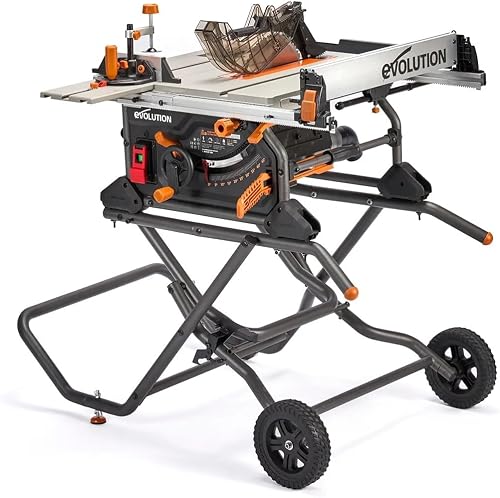
The R10TBLX's collapsible wheeled stand is the clearest difference.
 Best for mobile workshops
Evolution R10TBLX 10-Inch With Wheeled Stand

Evolution R10TBLX vs R10TS: what is the main difference?
The R10TBLX comes with a collapsible wheeled stand; the R10TS does not. That difference matters if you need to move the saw between work areas or store it after use.
The R10TBLX stand has all-terrain wheels and a quick-fold system. Its frame includes carry handles, onboard storage and an outfeed support bar.
The R10TS has carry handles, onboard storage and an outfeed support bar too, but you need to provide a stable surface or separate stand. Both models include a blade, so focus your comparison on how you will support the saw.
If you’re weighing other complete setups, our guide to table saws that come with a stand shows what to consider when the base is part of the package.
Do the R10TBLX and R10TS have the same cutting capacity?
Yes, both have a 26 in rip capacity, 3-3/8 in maximum cut depth and 0–45° bevel range. Their shared capacity means you can choose between them without giving up those stated dimensions.
Each uses a 10-inch blade and a rack and pinion fence system. Both also include a cross-cut sled and geared bevel adjustment.
Capacity is only one part of planning a cut. A wide sheet or long board needs room to enter and leave the saw, plus support that keeps the material level as you guide it.
For help judging whether 26 in is enough, see our table saw rip capacity guide. It walks through the kinds of cuts and stock widths that can shape your choice.
What cutting accessories come with both Evolution saws?
Both saws include a zero-clearance throat plate, dado plate and cross-cut sled. Those shared accessories give either model options for routine crosscuts and selected joinery work.
The zero-clearance throat plate supports the wood close to the blade opening. Evolution says this design can reduce tear-out and leave cleaner edges, which can be useful when a clean edge matters.
Evolution describes the dado plate as enabling dado and groove cutting. Before using a dado set, confirm the saw's compatible setup and limits in its manual, then follow the instructions for the blade and workpiece.
The cross-cut sled helps guide stock across the blade for crosscuts. For long or heavy pieces, plan a stable infeed and outfeed arrangement rather than relying on a small accessory to support the whole workpiece.
Which saw is a better fit for a mobile workshop?
The R10TBLX is the better fit when you need an included stand that folds and rolls. Its stand helps buyers who move the saw between job locations or need to put it away between projects.
Before choosing it, picture the entire routine: where it will travel, where the stand will unfold, and where the saw will go when the work is done. The wheels address movement, while the folded stand still needs a storage spot.
The R10TBLX also has an outfeed support bar. For large panels or long boards, arrange additional support as needed and keep the feed path clear so the workpiece stays controlled.
The R10TBLX is a weaker fit if your saw will remain in one place on a workbench or a suitable stand you already own. In that situation, the included wheeled base may add storage bulk without solving a problem you have.
When does the R10TS make more sense?
Choose the R10TS when you already have a stable workbench or a separate support setup. You get the same stated rip capacity, maximum cut depth and shared cutting accessories without an included wheeled stand.
This can suit a fixed home shop where the saw has a planned place and does not need to roll away. It can also suit a buyer who already owns a compatible support solution and prefers to arrange the workspace around it.
Skip the R10TS if you expect to use it straight from the box as a freestanding saw. It has carry handles, but handles are for moving the saw, not supporting it while you cut.
The R10TS has a limited warranty, but its duration is not specified here. If warranty length affects your decision, confirm the terms for the exact model before buying.
How do their safety features compare?
Both include an electronic blade brake, anti-kickback pawls and a riving knife. The R10TS also has a quick-release riving knife, a large paddle switch and a height-adjustable steel blade throat.
Safety features work as part of a proper setup and cutting routine. Keep the guard and riving knife in place for cuts that allow them, keep hands clear of the blade path, and support the workpiece so it does not twist or bind.
The R10TS's quick-release riving knife is a practical detail if your work calls for changing the knife setup. Follow the manual whenever you make an adjustment, and reinstall safety parts for the next cut where required.
Our guide to table saw safety features explains what the guard, riving knife and brake do. For a sound starting point, use how to align a table saw blade and fence after setup and before relying on repeated cuts.
How should you set up either Evolution jobsite saw?
Set up the saw on a stable, level surface with enough space to feed and support your work. The R10TBLX's stand helps create that surface; the R10TS requires you to supply it.
Unfold and lock the R10TBLX stand according to its manual, then check that the saw sits securely before cutting. If you choose the R10TS, use a support setup that holds the saw steady and keeps the table level.
Check that the fence and blade are aligned before making precision cuts. A fence that is out of alignment can lead to inaccurate work and a poor feed, so follow the manufacturer's setup instructions and make adjustments carefully.
Plan the power cord route before you start. Both are corded electric saws, so place the saw near a suitable power source and keep the cord out of the work and walking paths.
What common buying and setup mistakes should you avoid?
The biggest mistake is choosing by the saw's shared capacity while overlooking the support and space it needs. A 26 in rip capacity does not create room for sheet goods, long boards or a safe feed path.
Avoid assuming the R10TS includes a stand because it has carry handles and an outfeed support bar. Those features do not replace a stable base under the saw.
Do not treat the R10TBLX's wheels as a reason to skip checking the work area. You still need a clear, level place to unfold the stand, enough space to handle stock and a storage spot for the folded setup.
Another common error is changing accessories without checking compatibility and procedure. The included dado plate signals that dado and groove work is supported, but the saw's manual remains the guide for limits and correct setup.
Finally, do not ignore blade and fence alignment. Verify both as part of setup, especially before a project that depends on repeated, matching cuts.
Which Evolution saw should you buy?
Pick the R10TBLX if you want an included folding, wheeled stand; pick the R10TS if you have stable support already. Their shared cutting capacity and accessories make this a workspace decision more than a cutting-spec decision.
Choose the R10TBLX for a mobile setup, a garage where you need to fold the saw away, or a first jobsite saw purchase where you need the base included. Skip it if you have no room to store the stand or expect the saw to stay fixed on existing support.
Choose the R10TS for a planned bench or a separate support you already own. Skip it if you need a ready-to-roll setup and do not want to source a stand.
For a closer look at one model, read our Evolution R10TBLX review. If you're still comparing saw sizes, our table saw choosing and setup guide can help you decide what kind of saw fits your shop.
Frequently asked questions
What is the difference between the Evolution R10TBLX and R10TS?
The R10TBLX includes a collapsible wheeled stand, while the R10TS does not. Both share a 15A motor, 26 in rip capacity, 3-3/8 in maximum cut depth, dado plate, zero-clearance throat plate and cross-cut sled, so choose by the support setup you need.
Do both Evolution saws have the same rip capacity?
Yes. Both have a 26 in rip capacity, which describes the width available for a rip cut.
You still need enough room in front of and behind the saw to feed and support the workpiece safely.
Can the R10TS cut dadoes?
The R10TS includes a dado plate, and Evolution describes it as supporting dado and groove cutting. Check the manual for compatible dado setup, blade limits and operating steps before fitting a dado set.
Which Evolution saw is easier to move?
The R10TBLX includes a collapsible wheeled stand with all-terrain wheels and a quick-fold system. The R10TS has no included stand, so moving and supporting it depends on the separate setup you choose.
Do the R10TBLX and R10TS have the same safety features?
Both have an electronic blade brake, anti-kickback pawls and a riving knife. The R10TS also has a quick-release riving knife, large paddle switch and height-adjustable steel blade throat.


