Do You Need a Table Saw?
You need a table saw if you want straight, repeatable rips in plywood and long boards. If you mostly cut framing lumber to length or trim small pieces, a circular saw or miter saw does that job for less money and space.
On this page (8 sections)
- What does a table saw do that other saws can't?
- Do you need a table saw for the projects you actually build?
- When is a circular saw or miter saw the better buy?
- How much table saw do you need for a home shop?
- Which table saw size fits your shop and your work?
- How much space does a table saw really take?
- What safety and setup costs come with a table saw?
- So, do you need a table saw?
You need a table saw if you want straight, repeatable rips in plywood and long boards. If you mostly cut framing lumber to length or trim small pieces, a circular saw or miter saw does that work for less money and less floor space.
The question comes up because a table saw is the biggest single purchase in many home shops. The honest answer is that it earns its place for some projects and not others.
Here is how to tell which group you're in.
What does a table saw do that other saws can't?
A table saw holds the work flat and cuts against a fence, so each rip comes out the same width. That repeatability is the reason to own one.
A circular saw cuts straight only when you clamp a straightedge and measure the offset from the blade to the shoe, and you repeat that setup for every cut.
The fence is the key part. Set it once and push board after board through, and each piece matches the last.
That matters for cabinet parts, shelves, drawer sides and flooring, where a 1/16 inch drift shows up as a gap at the end of a run.
The table also supports the full sheet as it moves. A circular saw leaves most of a 4 by 8 sheet hanging off the edge of your workbench, which makes the cut wander.
Our guide to table saw rip capacity explains how wide a fence needs to reach for the sheet goods you buy.
Do you need a table saw for the projects you actually build?
You need one if your projects repeat the same width, or if you cut sheet goods. Shelving, cabinets, built-ins, a workbench top and deck boards all start with long straight rips.
A table saw turns those into a routine instead of a measuring exercise.
You can skip it if your projects are mostly crosscuts: cutting 2x4s to length, trimming a door, or fitting a few boards for a fence repair. A miter saw handles those faster and takes less room.
The same goes for rough framing, where speed and portability beat precision.
The middle group is the hard call. If you build something once or twice a year and the parts are short, a circular saw with a straightedge is enough.
If you plan a run of shelves or a cabinet build, the table saw pays for itself in time and in fewer ruined boards.
When is a circular saw or miter saw the better buy?
A circular saw wins when you break down full sheets or cut on site. It's light, it fits in a truck, and it handles crosscuts and rough rips.
The catch is that narrow, repeated rips take clamping and remeasuring each time.
A miter saw wins for crosscuts and angles. Trim, molding, framing studs and picture frames all go faster on a miter saw, and the blade stays square to the fence without a sled.
What it can't do is rip a board lengthwise.
Most home shops end up with two of the three. A miter saw for crosscuts plus a table saw for rips covers nearly every project.
A circular saw plus a table saw covers sheet goods and site work. A circular saw alone is the lightest setup, and the least repeatable.
If you're still weighing the whole purchase, how to buy a table saw walks through the size, fence and power choices in order.
How much table saw do you need for a home shop?
A 10-inch saw with a fence that reaches past 24 inches covers most home projects. That size handles 4 by 8 sheet goods, lumber up to about 3 inches thick, and the trim widths a typical shop needs.
An 8-1/4-inch compact saw suits smaller shops and lighter work.
The three saws below show the range. Each one is a real option for a different reader, and the first is the best pick for most home shops.
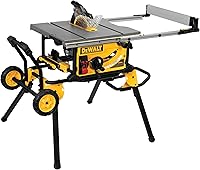
The DeWalt DWE7491RS carries a 15 amp motor and 4800 rpm, with a rack and pinion fence that stays parallel to the blade as you move it. Its 32-1/2 inch rip capacity takes full sheets and wide trim, and the depth of cut reaches 3-1/8 inches at 90 degrees.
The rolling stand folds for storage and rolls out for use, which helps in a garage that shares space with a car. It weighs 110 lb, so plan a spot where it can stay on its wheels.
The SKIL TS6307-00 has a 15 amp motor and a 25-1/2 inch rip capacity. Its legs fold into the saw, so it stores as one unit instead of two pieces.
It cuts 4x4 material at 90 degrees and bevels from 0 to 45 degrees with a quick release lever. At 51.2 lb it's lighter than the DeWalt, which matters if you carry it up stairs or load it alone.
The rack and pinion fence rails keep the fence parallel for repeatable cuts.
The DeWalt DWE7485 is the small-shop pick. Its 15 amp motor runs at 5800 rpm and its fence rips 24.5 inches, enough for a 4 by 8 sheet.
The compact size and 54 lb weight make it easy to move and store, and the metal roll cage base takes jobsite handling. The trade-off is a smaller blade: an 8-1/4 inch blade limits depth of cut compared with a 10-inch saw.
It suits a shop where the saw comes out for a project and goes back on a shelf.
Which table saw size fits your shop and your work?
Pick a 10-inch saw if you cut sheet goods and thick lumber, and an 8-1/4-inch saw if space and weight matter more. The blade size sets both the depth of cut and the width of the table, so it's the first decision.
A 10-inch saw gives you about 3 inches of depth at 90 degrees and a wider table to support a sheet. That suits cabinet work, shelving and any project using 2-inch lumber.
Both 10-inch saws above run 15 amp motors, so the power question is really about the motor, not the blade. Our guide to table saw horsepower covers how amp ratings translate into cutting power.
An 8-1/4-inch compact saw gives up depth and table area but takes less room. It's the better fit for a one-car garage, a basement shop or a bench that folds away.
It still rips a full sheet, so it isn't only a trim saw.
How much space does a table saw really take?
A table saw needs room in front of and behind the blade for the board to travel. A 10-inch saw's table might be about 21 by 26 inches, but the working space is much larger.
A 4 by 8 sheet needs about 4 feet of infeed in front and 8 feet of outfeed behind, so a garage bay or a driveway is the realistic spot.
The rolling stand on the DeWalt DWE7491RS and the folding legs on the SKIL help here. You can store either saw against a wall and roll or carry it out when you cut.
Our guide to table saw space requirements works through the clearances for a garage shop in detail.
Plan the outfeed first. A board that runs out of support at the back of the saw tips and binds, which is when kickback happens.
A roller stand or a second table at the same height solves it without more floor space.
What safety and setup costs come with a table saw?
Budget for a push stick, hearing and eye protection, and a dust hose. The saws above include a push stick and a blade guard, and the DeWalt DWE7491RS has a 2-1/2 inch dust port that connects to a vacuum.
The SKIL has a dust port elbow that sends dust to a container.
Setup takes longer than a circular saw. You'll check the blade is square to the table, set the fence parallel to the blade, and fit the riving knife and anti-kickback pawls.
The DeWalt Site-Pro guarding on the DWE7485 adjusts without tools, which speeds this up.
Keep the blade guard on for through cuts, and use the riving knife to reduce binding. A table saw is a safe tool when the guard, fence and push stick are in place.
It's the shortcuts that cause injuries, not the saw.
So, do you need a table saw?
Yes if straight, repeated rips in sheet goods and long boards are part of your projects. A table saw with a solid fence is the tool that makes those cuts accurate and repeatable, and a 10-inch saw covers most home work.
No if your work is mostly crosscuts, framing or one-off cuts, where a circular saw or miter saw does the job with less money and space.
The first pick for most home shops is the DeWalt DWE7491RS. Its 32-1/2 inch rip capacity, 15 amp motor and rolling stand handle full sheets and store against a wall.
The SKIL TS6307-00 is the pick when you want one unit with folding legs and a lighter lift. The DeWalt DWE7485 is the pick for a small shop where the saw shares space with everything else.
If you buy one, start with your widest rip. Check table saw rip capacity against the sheet goods you use, then how to buy a table saw for the rest of the choices.
Frequently asked questions
Do you need a table saw to build cabinets or shelving?
Yes, in most cases. Cabinet and shelving work needs straight, parallel rips in plywood and long boards, and a table saw with a fence repeats that cut width accurately.
A circular saw and straightedge can do it once, but the setup takes longer each time and the width drifts.
Can a circular saw replace a table saw?
A circular saw replaces a table saw for crosscuts, breaking down sheet goods, and one-off cuts. It struggles with narrow, repeatable rips, because the board has to be clamped to a straightedge and measured again each time.
For repeated widths in plywood or trim, a table saw is the better tool.
How much space does a table saw need?
A full-size table saw needs infeed and outfeed room for the longest board you cut, so a 4 by 8 foot sheet needs about 8 feet behind the blade and 4 feet in front. A compact or jobsite saw on a rolling stand needs less, but still more than the footprint of its table.
Is a table saw worth it for a home garage shop?
It is worth it if your projects involve plywood, shelving, trim, or repeated rip cuts. If you build once or twice a year and mostly cut boards to length, a circular saw or miter saw covers the work without taking up a wall.