8 Best Thin Kerf 10-Inch Table Saw Blades (November 2026)
The best best thin kerf 10 inch table saw blades include the WEN BL1060 10-Inch 60-Tooth Fine-Finish Professional Woodworking for clean crosscuts and general trim, the FOXBC 10-Inch Flat Tooth Ripping Table Saw for fast ripping of thick stock, and the DEWALT 10-Inch Miter / Table Saw Blade for a tough all-purpose rip blade.
On this page (7 sections)
- Best thin kerf 10 inch table saw blades compared
- How we compared these thin kerf 10 inch blades
- What kerf width should you choose on a 10-inch blade?
- Which tooth count fits your cuts?
- Will a thin kerf blade fit your table saw?
- Which thin kerf blade should you buy for plywood and sheet goods?
- Best thin kerf table saw blades 10 inch: the verdict
The best thin kerf 10 inch table saw blades for most shops start with the WEN BL1060, a 60-tooth fine-finish blade with a 2.4 mm kerf and a 5/8-inch arbor. Pick the FOXBC 24-tooth when you rip thick stock all day, or the Micro-Kerf 40T when every board counts.
Thin kerf blades cut a narrower slot than full kerf models. That means less wood turned into sawdust, less load on the motor and faster feed rates on saws with modest power.
The trade-off is a thinner plate that can flex more if you push it.
This roundup covers 10-inch thin kerf blades across three jobs: heavy ripping, general crosscutting and fine finish work. Our score weighs specs, features and fit for a 10-inch table saw against what each buyer needs.
If you're still deciding between blade styles, read our thin kerf vs full kerf table saw blade comparison first. Check your saw's arbor size in our guide to table saw blade sizes before you order.
Our picks at a glance
-
1
 Best for clean crosscuts and general trim
WEN BL1060 10-Inch 60-Tooth Fine-Finish Professional Woodworking
9.7/10 our score
See it on Amazon -
2
 Best for fast ripping of thick stock
FOXBC 10-Inch Flat Tooth Ripping Table Saw
9.6/10 our score
See it on Amazon -
3
 Best for a tough all-purpose rip blade
DEWALT 10-Inch Miter / Table Saw Blade
9.4/10 our score
See it on Amazon
- 4
 Check it
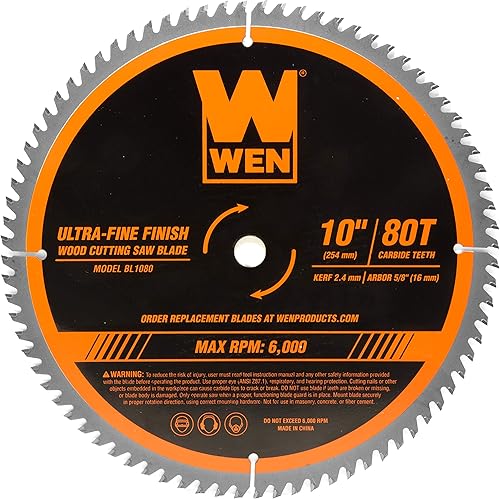
WEN BL1080 10-Inch 80-Tooth Carbide-Tipped Ultra-Fine Finish
Best for tearout-free finish cuts - 5
 Check it
Ryltanks 10 Inch Table/Miter Saw Blade 32T&60T&80T
Best for covering three cuts with one buy - 6
 Check it
10 Inch Micro-Kerf 40T 1/16 inch Thin Kerf
Best for saving material on costly stock - 7
 Check it
CRALY 10 Inch 80 Teeth Ultra Fine
Best for mixed wood and sheet goods - 8
 Check it
FOXBC 60-Tooth Thin Kerf Crosscut
Best for crosscutting moulding and plywood
Best thin kerf 10 inch table saw blades compared
The WEN BL1060 takes the top spot for general woodworking, while each blade below earns its place on a specific job. The order follows our scores, highest first.
WEN BL1060 10-Inch 60-Tooth Fine-Finish Professional Woodworking: Best for clean crosscuts and general trim
- 10-inch diameter
- 60 carbide-tipped teeth
- 2.4 mm thin kerf
- 5/8-inch arbor
- 6000 RPM rating
A 60-tooth fine-finish blade with a thin 2.4 mm kerf. It handles hard and soft woods and suits a shop that wants clean cuts without losing much material.
Pros
- Fine-finish 60-tooth cut
- Thin 2.4 mm kerf
- Rated to 6000 RPM
- Heat expansion slots
Cons
- Not the fastest for thick ripping
- Fine teeth need slower feed rates in wet stock
WEN's 60-tooth blade suits a shop that wants clean crosscuts and smooth trim from one blade. Its 2.4 mm kerf is thin enough to lighten the load on a 10-inch table saw, yet the 60 carbide teeth leave a fine finish in hard and soft woods.
WEN lists pine, oak, poplar, cherry, maple and walnut among the woods it handles.
The 5/8-inch arbor and 6000 RPM rating cover most 10-inch table, jobsite and miter saws. Heat expansion slots let the plate grow and shrink during long cuts, and WEN adds a protective coating that fights heat, rust and gumming.
WEN says the machine-cut teeth hold their shape and edge longer than the competition.
The trade-off is speed in thick stock. Sixty teeth feed slower than a 24-tooth rip blade, so a shop cutting thick hardwood all day would feel it.
For crosscuts, trim and general woodworking, it's the strongest all-round pick here.
Choose it as your everyday blade and add a rip blade for heavy stock. See the plywood blade for table saw guide if sheet goods make up most of your work.
FOXBC 10-Inch Flat Tooth Ripping Table Saw: Best for fast ripping of thick stock
- 10-inch diameter
- 24 flat teeth
- 0.094 in kerf
- 20 degree hook angle
- 5/8-inch arbor
A 24-tooth flat-tooth blade built for ripping stock from 3/4 to 2-3/4 inches thick. The 0.094 in kerf saves material and lightens the load on smaller saws.
Pros
- Fast 24-tooth ripping
- Narrow 0.094 in kerf
- 20 degree hook angle
- Also handles chipboard and laminates
Cons
- Rough finish on crosscuts
- Too aggressive for thin trim work
FOXBC's 24-tooth flat-tooth blade is built for ripping. It handles stock from 3/4 to 2-3/4 inches thick and also cuts chipboard or laminates, according to FOXBC.
The 20 degree hook angle and 0.094-inch kerf make fast work of long rip cuts. The plate measures 0.071 inches thick.
The flat tooth grind leaves a rougher edge than an ATB blade. That's the point: fewer teeth and a flat profile clear chips quickly and keep the blade cool in thick material.
A 10-inch table saw with a smaller motor benefits most from the narrow kerf. FOXBC uses high-density tungsten carbide for wear resistance and lists less vibration and noise as part of the thin kerf design.
Compared with the WEN BL1060, this blade trades finish for speed. It's the one to fit when you break down rough lumber into blanks.
Keep the 60-tooth blade nearby for the final dimension cuts. FOXBC also lists strong results when crosscutting wood or working with plywood, so it can do more than rip if needed.
Skip it if you mostly crosscut trim or cut veneered plywood. The flat teeth will tear out the surface on those jobs.
If your saw is a smaller 8-1/4-inch model, read our 8 1/4 vs 10 inch table saw comparison before buying a 10-inch blade.
DEWALT 10-Inch Miter / Table Saw Blade: Best for a tough all-purpose rip blade
- 10-inch diameter
- 24-tooth ATB grind
- Thin kerf
- 5/8-inch arbor
- Wedge shoulder design
DEWALT's 24-tooth thin kerf blade for table and miter saws. The wedge shoulder design puts more steel behind each tip for durability and accuracy.
Pros
- Thin kerf for fast cutting
- Computer-balanced plate
- Wedge shoulder tip support
- Works on table and miter saws
Cons
- 24 teeth leave a rougher cut than fine-finish blades
- Not the choice for finish crosscuts
DEWALT's 24-tooth thin kerf blade takes the middle ground between speed and durability. Its wedge shoulder design puts more steel behind each carbide tip, which DEWALT says adds durability and accuracy.
The computer-balanced plate cuts vibration for a cleaner cut.
It fits both table saws and miter saws with a 5/8-inch arbor. That makes it a practical spare for a shop that wants one blade for two tools.
The thin kerf keeps cutting fast and smooth, and the 24 teeth handle general ripping and framing work. DEWALT lists engineered wood among the materials it cuts and backs the blade with a one-year full warranty.
Against the FOXBC 24-tooth, this blade leans toward toughness rather than the narrowest cut. It's the safer choice when you hit an occasional knot or nail and don't want to lose a tip.
The trade-off is that the 24 teeth still leave a rougher surface than a 60-tooth blade on crosscuts.
Choose it if you want a durable rip blade that also sees miter saw duty. Skip it for finish crosscuts where a 60- or 80-tooth blade does better.
WEN BL1080 10-Inch 80-Tooth Carbide-Tipped Ultra-Fine Finish: Best for tearout-free finish cuts
- 10-inch diameter
- 80 carbide-tipped teeth
- 2.4 mm thin kerf
- 5/8-inch arbor
- 6000 RPM rating
An 80-tooth blade for ultra-fine finish work in hard and soft woods. The thin 2.4 mm kerf keeps cuts efficient while the high tooth count limits tearout.
Pros
- Ultra-fine 80-tooth finish
- Thin 2.4 mm kerf
- Rated to 6000 RPM
- Works on table, miter and jobsite saws
Cons
- Slow in thick stock
- 80 teeth are easy to chip on hard knots
WEN's 80-tooth blade is the fine-finish option in this group. With 80 carbide teeth and a 2.4 mm kerf, it leaves an ultra-fine edge in hard and soft woods while keeping the cut efficient.
The 5/8-inch arbor and 6000 RPM rating match the BL1060.
This is the blade for trim, veneered panels and anything where tearout shows. The high tooth count takes small bites, so the surface stays clean.
The thin kerf means less material removed than a full kerf finish blade. WEN's protective coating also fights heat, rust and resin buildup on the plate.
The trade-off is speed. Eighty teeth feed slowly in thick stock, and the fine tips are more fragile around hard knots.
Use it as a dedicated finish blade rather than a do-everything blade. It shares the same 2.4 mm kerf as the BL1060, so switching between the two changes the cut quality without changing the material loss.
Pick it when surface quality matters more than speed. It pairs well with the BL1060: keep the 60-tooth for general work and switch to the 80-tooth for visible faces.
Ryltanks 10 Inch Table/Miter Saw Blade 32T&60T&80T: Best for covering three cuts with one buy
- 10-inch diameter
- 32T, 60T and 80T blades
- 0.098 in kerf
- 5/8-inch arbor
- 6000 RPM rating
A three-blade pack with 32, 60 and 80 teeth on the same 5/8-inch arbor. It gives a small shop a blade for framing, crosscutting and fine trim without buying separately.
Pros
- Three tooth counts in one pack
- Thin 2.5 mm kerf
- Rated to 6000 RPM
- Handles plywood, melamine and OSB
Cons
- Thicker kerf than the WEN blades
- Each blade gets less individual quality than a single premium pick
Ryltanks sells three thin kerf blades in one pack: 32, 60 and 80 teeth on a shared 5/8-inch arbor. Each blade has a 0.098-inch kerf and a 6000 RPM rating.
Ryltanks lists the 32T for framing, the 60T for ripping and crosscutting, and the 80T for fine finish.
For a small shop or a first table saw, this pack covers more cuts than any single blade here. The 32T handles rough work, the 60T does general cuts and the 80T finishes surfaces.
Ryltanks says the blades cut plywood, melamine and OSB as well as solid wood, and the pack also lists nail-embedded wood as fair game. Laser-cut stabilizer vents keep noise and vibration low.
The trade-off is depth per blade. At 0.098 inches the kerf is thicker than the WEN blades, so you save less material.
Each blade also gets less individual quality than a single premium pick, since the cost is spread across three blades. The 2.5 mm kerf sits close to a standard thin kerf, so the savings are modest.
Choose it if you want one order to cover framing, crosscutting and finish work. Skip it if you only need one great general-purpose blade.
10 Inch Micro-Kerf 40T 1/16 inch Thin Kerf: Best for saving material on costly stock
- 10-inch diameter
- 40 carbide teeth
- 0.061 in micro kerf
- 5/8-inch arbor
- Made in USA
A 40-tooth blade with a 1/16-inch micro kerf, made in the USA. The stiffening collars cut noise and vibration, and the narrow kerf saves material on expensive wood.
Pros
- Narrowest kerf in this group at 0.061 in
- Noise-dampening stiffening collars
- Glue line quality rips and crosscuts
- Sharpens up to 15 times
Cons
- Not for scoring or partial-depth cuts
- Thin plate needs care when handling
The Micro-Kerf 40T is the material saver. Its 0.061-inch kerf is the narrowest in this group, so it turns far less wood into sawdust than a full kerf blade.
Total Saw Solutions makes it in the USA with a 0.001-inch runout spec and micro-grain carbide that sharpens up to 15 times.
Stiffening collars held by copper rivets sandwich the thin plate. That cuts noise and vibration, and the blade makes smooth, quiet cuts with minimal dust.
It's rated for glue line quality rips and crosscuts in hard and soft wood. The maker lists a 2-1/2 inch depth of cut on table saws and 2-5/8 inches on miter saws.
Read the maker's limits carefully. This is not a full-depth scoring blade, and when a cut doesn't go all the way through, each pass must be limited to a maximum 1-1/2 inch depth.
The 40 teeth suit general work but won't match an 80-tooth blade on finish. It also handles composites and plastics, so it covers more than wood.
Pick it when you cut costly hardwood or thin stock and want to keep every inch. Skip it for deep through-cuts in thick timber.
CRALY 10 Inch 80 Teeth Ultra Fine: Best for mixed wood and sheet goods
- 10-inch diameter
- 80 ATB teeth
- 2.4 mm kerf
- 5/8-inch arbor
- Black Ice non-stick coating
An 80-tooth blade with a thin 2.4 mm kerf and a Black Ice anti-stick coating. It suits shops cutting softwood, hardwood, plywood, MDF and laminates on one blade.
Pros
- 80-tooth fine finish
- Non-stick coating reduces friction
- Laser-cut expansion slots
- Handles plywood and laminates
Cons
- High tooth count slows thick ripping
- Not as tough as flat-tooth blades on nail-embedded wood
CRALY's 80-tooth blade targets shops that cut several materials on one saw. It has 80 ATB teeth and a 2.4 mm kerf, with a Black Ice non-stick coating that CRALY says reduces friction, heat and corrosion.
Laser-cut expansion slots and stabilizer vents keep noise and vibration down.
CRALY lists it for softwood, hardwood, plywood, MDF, OSB and laminates. That range makes it a practical finish blade for cabinet and trim work where sheet goods and solid stock meet.
The high-density tungsten carbide is meant to hold a clean cutting surface over a long life.
The trade-off matches the other 80-tooth picks: slow feed in thick stock. The coating helps with resinous woods and laminates, but the fine teeth still need steady, unhurried passes.
It's a good second blade next to a 24-tooth rip blade. CRALY's own copy claims the blade handles nails, but a flat-tooth rip blade remains the tougher choice for that kind of rough stock.
Choose it if your work mixes plywood and solid wood and you want a clean surface. Skip it if you need one blade for heavy ripping.
FOXBC 60-Tooth Thin Kerf Crosscut: Best for crosscutting moulding and plywood
- 10-inch diameter
- 60-tooth ATB grind
- 0.087 in kerf
- 5/8-inch arbor
- Fits DeWalt and Skil 10-inch saws
A 60-tooth ATB blade with a 0.087 in kerf for fine crosscuts. It handles oak, pine, melamine, plywood and moulding, and fits many 10-inch DeWalt and Skil saws.
Pros
- Fine crosscut finish
- Narrow 0.087 in kerf
- ATB tooth grind
- Fits many DeWalt and Skil saws
Cons
- Lowest score in this group
- Not designed for heavy ripping
FOXBC's 60-tooth ATB blade is built for crosscuts. Its 0.087-inch kerf is narrower than most here, and the ATB grind leaves a fine finish in oak, pine, melamine, plywood and moulding.
FOXBC names DeWalt DWE7491RS and DWS713 and Skil TS6307-00 and SPT99-11 among compatible saws.
That compatibility matters if you own a common 10-inch jobsite saw. The thin kerf keeps the load light on those saws' motors.
It's a solid choice for trim carpenters who cut moulding and sheet goods more than they rip lumber. FOXBC builds it from high-density tungsten carbide and lists reduced vibration and noise as part of the thin kerf design.
It scores lowest in this group because it's the most specialized. The 60 teeth crosscut well but won't match the flat-tooth FOXBC on thick ripping.
If you already own a rip blade, this is a good partner for finish cuts.
Pick it for crosscutting and trim work on a DeWalt or Skil saw. Skip it as your only blade if ripping is a big part of your work.
How we compared these thin kerf 10 inch blades
We started with the specs that decide how a blade behaves on a 10-inch table saw: kerf width, tooth count and grind, arbor size and RPM rating. Then we weighed each blade against the job it claims to do, whether that's ripping, crosscutting or fine finish.
A blade with a narrow kerf and a matching tooth count for its job scored higher than one with a thicker kerf or a grind that fights its stated use. We also noted the plate features that limit flex, such as stiffening collars, expansion slots and balanced plates.
The Micro-Kerf's collars and the DEWALT's wedge shoulder both count in that column.
Every blade here is 10-inch with a 5/8-inch arbor. If your saw uses a different arbor or a smaller blade, check the fit before ordering.
Our scores reflect fit for a typical 10-inch table saw and the buyer who needs that blade's job done well. Blades sold as packs were judged on how well each tooth count covers its assigned cut, not just on the count of blades in the box.
| Product | Best for | Diameter | Kerf | Teeth | Our score |
|---|---|---|---|---|---|
| WEN BL1060 10-Inch 60-Tooth Fine-Finish Professional Woodworking | clean crosscuts and general trim | 10 in | 2.4 mm (0.1 in) | 60 | 9.7 |
| FOXBC 10-Inch Flat Tooth Ripping Table Saw | fast ripping of thick stock | 10 in | 0.094 in | 24 | 9.6 |
| DEWALT 10-Inch Miter / Table Saw Blade | a tough all-purpose rip blade | 10 in | Thin kerf | 24 | 9.4 |
| WEN BL1080 10-Inch 80-Tooth Carbide-Tipped Ultra-Fine Finish | tearout-free finish cuts | 10 in | 2.4 mm (0.1 in) | 80 | 8.9 |
| Ryltanks 10 Inch Table/Miter Saw Blade 32T&60T&80T | covering three cuts with one buy | 10 in | 0.098 in (2.5 mm) | 32, 60 and 80 | 8.6 |
| 10 Inch Micro-Kerf 40T 1/16 inch Thin Kerf | saving material on costly stock | 10 in | 0.061 in | 40 | 8.4 |
| CRALY 10 Inch 80 Teeth Ultra Fine | mixed wood and sheet goods | 10 in | 2.4 mm | 80 | 8.2 |
| FOXBC 60-Tooth Thin Kerf Crosscut | crosscutting moulding and plywood | 10 in | 0.087 in | 60 | 7.7 |
What kerf width should you choose on a 10-inch blade?
Pick the narrowest kerf you can run safely for the work. A thinner kerf removes less wood, needs less motor power and feeds faster.
The blades here run from 0.061 inches on the Micro-Kerf to about 0.1 inches on the WEN pair. The FOXBC pair sits between them at 0.087 and 0.094 inches.
Kerf width changes what a blade is good at. Here's how the ranges break down.
Under 0.07 inches: maximum material savings
The Micro-Kerf 40T sits here at 0.061 inches. Blades this thin save the most wood and cut quietly when they have stiffening collars.
They suit costly hardwood, veneer and repeated cuts where every board matters. They need steady feed and care in handling.
0.087 to 0.1 inches: the everyday thin kerf range
Most picks here fall in this band. The WEN blades run 2.4 mm (about 0.1 inches), the FOXBC crosscut and rip blades sit at 0.087 and 0.094 inches, and the Ryltanks set runs 0.098 inches.
These kerfs balance material savings with a stiffer plate and easy availability in all tooth counts. The CRALY blade also lands at 2.4 mm here.
When a full kerf makes more sense
Full kerf blades cut about 1/8 inch wide. They flex less and hold up better in heavy production cutting.
A shop running a powerful cabinet saw all day may not need the material savings of a thin kerf. Our thin kerf vs full kerf table saw blade guide covers when each style wins.
Which tooth count fits your cuts?
Match the tooth count to the cut you make most. 24 teeth rip fast, 40 to 60 handle general crosscuts and 80 leaves the finest finish.
Buying one blade outside its job costs you either speed or surface quality.
24 teeth: ripping and rough stock
The FOXBC 24-tooth and DEWALT 24-tooth blades sit here. They clear chips fast and stay cool in thick stock.
Pick one when you break down rough lumber or frame with 2x material. Expect a rougher edge that needs a finish pass or sanding.
The flat tooth grind on the FOXBC leaves the roughest edge but clears chips fastest.
40 to 60 teeth: crosscuts and general work
The WEN BL1060 at 60 teeth and the Micro-Kerf 40T anchor this range. A 60-tooth blade leaves a clean crosscut and handles trim, while 40 teeth move faster in mixed work.
The Micro-Kerf 40T also cuts composites and plastics, so it earns its place outside pure woodworking. For a single everyday blade in a small shop, 60 teeth is the safer middle choice.
80 teeth: finish cuts and sheet goods
The WEN BL1080, CRALY 80-tooth and the 80T blade in the Ryltanks pack cover this range. They leave the cleanest surface in thin stock and veneered panels.
Feed them slowly and keep them out of hard knots and nail-embedded wood. The CRALY coating gives it an edge on resinous woods and laminates.
Will a thin kerf blade fit your table saw?
Check three things before you buy: diameter, arbor size and RPM rating. All the blades here are 10-inch with a 5/8-inch arbor and a 6000 RPM rating, which covers most 10-inch table saws.
Confirm your saw's arbor before ordering.
Diameter and arbor size
A 10-inch blade needs a saw built for 10-inch blades. Most full-size table saws take that size.
Compact and jobsite saws often use 8-1/4 inches, so check before buying. Our 8 1/4 vs 10 inch table saw comparison explains the difference in cut depth and motor load.
The 5/8-inch arbor is the common size for 10-inch saws, and every blade here uses it.
RPM rating and motor power
Never fit a blade rated below your saw's no-load speed. A 6000 RPM rating clears most 10-inch table saws.
On a low-power saw, a thin kerf blade helps the motor keep its speed, which is why thin kerf is the usual pick for jobsite models. Our table saw blade sizes guide covers ratings and fit in more detail.
Which thin kerf blade should you buy for plywood and sheet goods?
For plywood and sheet goods, choose an 80-tooth thin kerf blade with an ATB grind. The CRALY 80-tooth or the WEN BL1080 both limit tearout on veneered faces.
The finer teeth take smaller bites and leave a cleaner edge than a 24-tooth rip blade.
The FOXBC 60-tooth crosscut blade also works well on plywood and melamine according to FOXBC. It splits the difference between speed and finish.
For a dedicated sheet-goods blade, our plywood blade for table saw guide compares the options in more depth.
Feed plywood steadily and support the offcut to stop chipout on the bottom face. A zero-clearance throat plate helps too, whatever blade you fit.
If you cut a lot of melamine or laminate, the CRALY's non-stick coating is a small plus on resinous surfaces. The Ryltanks 80T also lists plywood and melamine among the materials it cuts.
Best thin kerf table saw blades 10 inch: the verdict
The best thin kerf 10 inch table saw blade for most shops is the WEN BL1060. Its 60-tooth fine-finish cut, 2.4 mm kerf and 6000 RPM rating handle general woodworking without the flex worries of the thinnest plates.
For heavy ripping, the FOXBC 24-tooth is the pick, with its 0.094-inch kerf and 20 degree hook angle. If material savings matter most, the Micro-Kerf 40T at 0.061 inches keeps the most wood on the bench.
The WEN BL1080 is the choice for the cleanest finish cuts.
Start with the BL1060 as your everyday blade and add a rip blade when thick stock becomes routine. Check your arbor size first in our table saw blade sizes guide so the blade fits your saw on day one.
Our top 3 picks at a glance
-
1
Best for clean crosscuts and general trim
WEN BL1060 10-Inch 60-Tooth Fine-Finish Professional Woodworking
9.7/10 our score
See it on Amazon -
2
Best for fast ripping of thick stock
FOXBC 10-Inch Flat Tooth Ripping Table Saw
9.6/10 our score
See it on Amazon -
3
Best for a tough all-purpose rip blade
DEWALT 10-Inch Miter / Table Saw Blade
9.4/10 our score
See it on Amazon
Frequently asked questions
Do I need a thin kerf blade on a small table saw?
Yes, a thin kerf blade helps on saws with less motor power. It removes less material per cut, so the motor works less hard and the blade keeps its speed in thicker stock.
That makes it the usual pick for jobsite and compact saws.
What tooth count should I choose?
Pick 24 teeth for fast ripping, 40 to 60 for general crosscuts and trim, and 80 for the cleanest finish on thin stock. Thin kerf blades come in all three counts, so match the count to the cut you make most.
Is a thin kerf blade less accurate?
A thin kerf blade can flex more than a full kerf blade because its plate is thinner. Blades with stabilizers, stiffening collars or balanced plates limit that flex.
Feed stock steadily and let the blade finish each cut for straight results.
Do thin kerf blades waste less wood?
Yes. A 0.061-inch kerf removes far less material than a 1/8-inch full kerf.
On expensive hardwood or repeated cuts from sheet goods, the saved material adds up quickly.
The Micro-Kerf 40T is the narrowest pick here.


