8 Best Plywood Blades for Table Saws (October 2026)
The best table saw blades for plywood include the Freud LU80R010 Plywood and Melamine Blade for veneer and melamine, the Freud Thin Kerf Plywood and Melamine Blade for lower-powered saws, and the Diablo D1080X 80-Tooth Blade for mixed fine cuts.
On this page (9 sections)
- How should you choose the best plywood blade for a table saw?
- Which plywood blades fit different table saw jobs?
- Does tooth count make the biggest difference in plywood cuts?
- Is a thin kerf blade the right choice for plywood?
- How can you set up a table saw for cleaner plywood edges?
- What common mistakes cause plywood tear-out?
- How should you care for a plywood blade?
- Can one blade cut plywood and solid wood?
- Which plywood blade should you choose?
The Freud LU80R010 is the best plywood blade for most table saws when you want a clean finish on veneer, melamine, or laminate. This guide to the best plywood blade for table saw work also covers thin kerf options, crosscut blades, and choices for mixed sheet goods.
A finish blade can improve the cut edge, but it cannot compensate for a loose fence, unsupported sheet, or blade that does not suit the saw. Start by checking fit, then choose a tooth design and kerf that match the cuts you make most.
For a quick check of diameter and arbor, use our table saw blade size guide. A zero clearance insert can support fibers near the blade, which is useful when you want cleaner edges.
Our picks at a glance
-
1
 Best for veneer and melamine
Freud LU80R010 Plywood and Melamine Blade
9.0/10 our score
See it on Amazon -
2
 Best for lower-powered saws
Freud Thin Kerf Plywood and Melamine Blade
8.6/10 our score
See it on Amazon -
3

- 4
 Check it
CMT 255.080.10 Fine Finishing Blade
Best for thin kerf finishes - 5
 Check it
FOXBC 60-Tooth Thin Kerf Crosscut Blade
Best for panel crosscuts - 6
 Check it
CMT 221.060.10 Laminate and Chipboard Blade
Best for assorted sheet goods - 7
 Check it
Revvstark 80-Tooth 10-Inch Blade
Best for varied panel materials - 8
 Best for broad wood cutsCheck it
How should you choose the best plywood blade for a table saw?
Choose a blade by matching its fit, tooth design, kerf, and intended cuts to your saw and plywood. A high tooth count can help with finish work, but the whole setup determines whether a panel cuts cleanly.
First, confirm the blade diameter and arbor against the saw manual. A blade that physically mounts may still be wrong if its kerf, plate, or speed limit does not match the saw or its safety parts.
Next, decide whether the main job is clean crosscuts, repeated long rips, or general panel work. Plywood veneers and melamine call for attention to edge quality; ripping long strips calls for a blade suited to the cut and a controlled feed.
Finally, consider the saw's power and the riving knife. A thin kerf removes less material, but it must remain compatible with the saw's knife and operating guidance.
Which plywood blades fit different table saw jobs?
The Freud LU80R010 is the clearest match for veneer and melamine finish cuts. The other choices suit narrower kerfs, broader panel materials, or a mix of fine cuts.
Our scores weigh each blade's stated features and fit for plywood work. Use the individual distinctions below to choose for your material and saw.
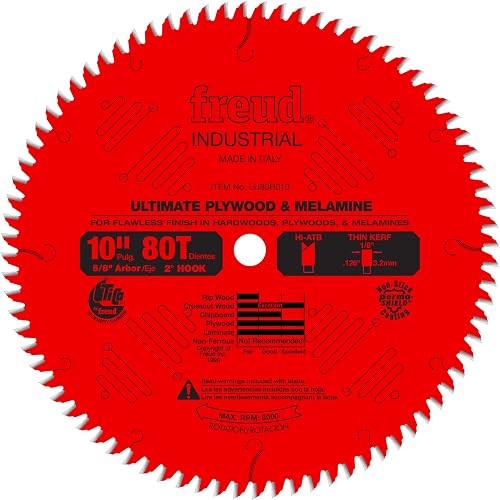
Freud LU80R010 Plywood and Melamine Blade: Best for veneer and melamine
- 10 in diameter
- 80 teeth
- Hi-ATB grind
- 0.126 in kerf
- Perma-Shield coating
Its 80-tooth Hi-ATB design is made for smooth cuts in veneer, melamine, and laminate. The full 0.126 in kerf is worth checking against your saw's power and current blade.
Pros
- Hi-ATB teeth for splinter-free cuts
- Anti-vibration slots
- Non-stick coating
Cons
- Full kerf may ask more of a saw than a thin kerf blade
Freud's LU80R010 is the dedicated plywood and melamine pick here. Its 80 Hi-ATB teeth are designed for clean cuts in veneered plywood, melamine, and laminate.
The blade has a 0.126 in kerf, so check the saw manual and riving knife before fitting it. The Perma-Shield coating is intended to reduce drag and pitch buildup, while laser-cut anti-vibration slots are designed to limit sideways movement.
Choose it when finish quality on veneered sheet goods is the priority and your saw accepts its kerf. Skip it if your saw requires a thin kerf blade or you mainly make long rip cuts.
Freud Thin Kerf Plywood and Melamine Blade: Best for lower-powered saws
- 10 in diameter
- 80 teeth
- Hi-ATB tooth design
- Thin kerf
- Perma-Shield coating
This thin kerf Freud keeps the 80-tooth Hi-ATB design for finish cuts in plywood and melamine. Its narrower cut can suit a saw that has less power available.
Pros
- Thin kerf
- Hi-ATB geometry
- Anti-vibration slots
Cons
- Exact kerf width is not specified here
The Freud LU79R010 combines an 80-tooth Hi-ATB design with a thin kerf. That makes it the better Freud fit for a saw setup where removing less material per pass matters.
Freud describes it for veneered plywood, melamine, laminates, fine molding, and solid wood crosscuts. Anti-vibration slots and Perma-Shield coating are also part of the design.
Its exact kerf width is not specified, so check the blade details and your saw manual before buying. Choose it for finish work where a narrower cut is useful; skip it if you need a precisely stated kerf for compatibility planning.
Diablo D1080X 80-Tooth Blade: Best for mixed fine cuts
- 10 in diameter
- 80 teeth
- 5/8 in arbor
- PermaShield coating
The 80-tooth blade is described for fine woodworking and trim, with wood and composite materials among its uses. Its 5/8 in arbor fits many standard 10 in saws, subject to your saw's manual.
Pros
- 80 teeth for fine cuts
- 5/8 in arbor
- Named for table saw use
Cons
- Not described as a plywood-specific blade
The Diablo D1080X is a flexible choice for fine cuts across wood and composite materials. It has 80 teeth and a 5/8 in arbor, and it is described for table saws as well as miter and chop saws.
It is less specialized than the two Freud plywood and melamine blades. Choose it if your projects mix plywood with trim and other fine woodworking; skip it if you want a blade whose stated purpose is specifically veneer or melamine finishing.
The kerf width is not specified here. Confirm the diameter, arbor, and all fit requirements in your saw manual before installation.
CMT 255.080.10 Fine Finishing Blade: Best for thin kerf finishes
- 10 in diameter
- 80 teeth
- 0.110 in kerf
- 0.071 in plate
- Hi-ATB
Its 80-tooth Hi-ATB design and 0.110 in kerf suit fine finishing, including veneer plywood and two-sided laminate work. Check the saw's manual for compatibility before fitting it.
Pros
- Thin 0.110 in kerf
- Hi-ATB teeth
- Compatible with table saws
Cons
- Brand model numbers differ between the product title and specifications
CMT's 255.080.10 is a thin kerf finish option for veneer plywood and two-sided laminate. Its Hi-ATB geometry, 80 teeth, and 0.110 in kerf make it a focused pick when both edge quality and a narrower cut matter.
The plate is 0.071 in thick. Product details give two different model numbers, 255.080.10 and 254.080.10, so confirm the exact version and compatibility before ordering.
Choose it for fine sheet work if its dimensions suit your saw. Skip it if you need an uncomplicated model match or primarily want a general-purpose ripping blade.
FOXBC 60-Tooth Thin Kerf Crosscut Blade: Best for panel crosscuts
- 10 in diameter
- 60 teeth
- 0.087 in kerf
- ATB teeth
This thin kerf blade is described for crosscutting plywood, melamine, and molding. Its 60 teeth make it a more focused crosscut option than the 80-tooth finishing blades.
Pros
- 0.087 in kerf
- Plywood listed among intended materials
- Fits many 10 in table saws
Cons
- Crosscut focus is less suited to a single blade for varied work
The FOXBC 60-tooth blade is aimed at crosscutting plywood, melamine, and molding. Its 0.087 in kerf is notably narrow among these picks, and FOXBC names several 10 in saw families as compatible.
It has fewer teeth than the 80-tooth finish blades, so its appeal is the combination of crosscut focus and thin kerf. Choose it for panel crosscuts and molding when the fit matches your saw.
Skip it if your work needs one blade for regular ripping and varied cuts. Check the model and manual rather than relying on a compatibility list alone.
CMT 221.060.10 Laminate and Chipboard Blade: Best for assorted sheet goods
- 10 in diameter
- 60 teeth
- 0.126 in kerf
- PTFE coating
CMT names plywood, laminate, chipboard, and melamine among the intended materials. The 60-tooth design is a useful fit for sheet goods when a dedicated finish blade is not the main need.
Pros
- Plywood and laminate are named uses
- PTFE coating
- Stationary table saw compatibility
Cons
- 0.126 in kerf needs a compatibility check
CMT's 221.060.10 is the broad sheet-goods choice for plywood, laminate, chipboard, and melamine. It has 60 teeth and a 0.126 in kerf, with compatibility described for stationary table saws and several other saw types.
The PTFE coating is intended to reduce friction and pitch buildup. Laser-cut expansion and sound-dampening slots and a tensioning ring are also specified.
Choose this blade when one tool needs to handle several engineered panels. Skip it if you need a thin kerf finish blade or a dedicated veneer-focused design.
Revvstark 80-Tooth 10-Inch Blade: Best for varied panel materials
- 10 in diameter
- 80 teeth
- 5/8 in arbor
- Plywood and laminate use
This 80-tooth blade is described for plywood, MDF, chipboard, and laminated panels. The 5/8 in arbor and stated maximum speed are details to compare with your saw's manual.
Pros
- Plywood and laminated panels are named uses
- 80 teeth
- 5/8 in arbor
Cons
- No kerf width is specified here
The Revvstark 80-tooth blade covers plywood, chipboard, MDF, and laminated panels. Its 5/8 in arbor and 7,000 rpm maximum speed give you specific compatibility points to compare with your saw.
The blade also has noise-reducing perforations and thermal expansion grooves. Kerf width is not stated, so don't assume it will fit a thin kerf setup.
Choose it if your projects move among different panel materials and your saw's specifications match. Skip it if you need a known kerf dimension or a more narrowly defined veneer finish blade.
OSTTE 80-Tooth 10-Inch Blade: Best for broad wood cuts
- 10 in diameter
- 80 teeth
- 5/8 in arbor
- Plywood and laminate use
OSTTE describes this 80-tooth blade for plywood, MDF, laminate, hardwood, and softwood. It may suit a buyer wanting one blade for several wood materials.
Pros
- Plywood and laminate are named uses
- ATB teeth
- 5/8 in arbor
Cons
- No kerf width is specified here
The OSTTE 80-tooth blade is described for plywood, MDF, laminate, chipboard, hardwood, and softwood. Its ATB teeth are intended to reduce tear-out on both sides of the cut, and its stated maximum speed is 5,500 rpm.
Check that speed limit, diameter, arbor, and kerf compatibility before mounting it. The kerf width is not specified here.
Choose it for broad wood and panel use if the fit checks out. Skip it when veneer finish is the top requirement and you want a more specialized plywood blade.
Does tooth count make the biggest difference in plywood cuts?
Tooth count helps describe a blade's intended cut, but it does not decide finish quality by itself. These picks include 80-tooth blades aimed at finer work and 60-tooth blades described for crosscuts or multiple panel materials.
The tooth geometry matters too. Hi-ATB and ATB profiles shear fibers at an angle, which is why several of these blades are positioned for cleaner edges.
For a finish cut, keep the blade sharp and feed the panel smoothly. If the cut edge still chips, check support, alignment, and the insert opening before assuming that a higher tooth count is the answer.
Is a thin kerf blade the right choice for plywood?
A thin kerf blade removes less material per pass and may suit a saw with less power available. It also needs to match the saw's riving knife and the limits in the manual.
The Freud LU79R010, CMT 255.080.10, and FOXBC blade are thin kerf options in this group. The CMT and FOXBC options state kerf widths, while the Freud LU79R010 does not.
Do not choose by kerf alone. Read thin kerf versus full kerf table saw blades and confirm that the blade and knife work together as intended.
How can you set up a table saw for cleaner plywood edges?
A clean setup starts with a blade that is installed correctly, aligned with the saw, and supported by a stable work surface. Disconnect power before changing a blade or adjusting parts, and follow the saw manual for each step.
Check that the blade is secure and oriented correctly, then set its height according to the saw maker's instructions. Align the fence parallel to the blade and verify the insert does not bind or rub.
Support the sheet on both sides of the cut so it cannot sag or twist. Large plywood panels are awkward to control on a small table, so arrange suitable infeed and outfeed support before starting.
Use the guard and riving knife or splitter where the saw and cut allow them. The table saw safety features guide explains the purpose of those parts, and our roller stand guide covers outfeed support.
What common mistakes cause plywood tear-out?
A dull or dirty blade, a hurried feed, and a panel that moves during the cut can all spoil the edge. Start with a clean blade and stable support before changing the blade choice.
A fence that is not aligned can pinch the work or steer it off line. Learn how to align a table saw blade and fence before diagnosing repeated burn marks or uneven cuts.
Another common mistake is buying by diameter alone. Arbor, kerf, plate thickness, and speed limits matter too, and an incorrect match can affect how the blade sits or how the riving knife functions.
Avoid forcing the panel through the cut. Keep a controlled feed, use a push stick when the cut requires one, and stop if the work binds or shifts.
How should you care for a plywood blade?
Keep the blade clean and inspect it before use. Resin and dust can build up around teeth and plate, which can interfere with smooth cutting.
Follow the blade maker's cleaning and sharpening guidance. Don't use a blade with damaged teeth, and store it so the carbide edges are protected from contact with other tools.
If the saw starts cutting roughly, check for buildup, alignment, and support before pushing harder. A clean, sharp blade and steady feed help preserve the finish the tooth design is meant to produce.
Can one blade cut plywood and solid wood?
Yes, several picks are described for both plywood and solid wood or other wood materials. The Freud LU79R010 is described for solid wood crosscuts, while the Diablo and OSTTE blades have broader wood-use descriptions.
A single blade can simplify a small shop, but a finish-oriented blade may not be the best choice for frequent long rips. Match the blade to the cut you make most often, and change blades when the job's demands differ.
For grooves and slots, use a suitable dado setup rather than treating a plywood blade as a substitute. Our dado set guide covers that separate choice.
Which plywood blade should you choose?
Choose the Freud LU80R010 when veneer, melamine, or laminate finish quality comes first and your saw accepts its 0.126 in kerf. Choose the Freud LU79R010 when you want a similar 80-tooth finish approach with a thin kerf, after confirming compatibility.
Pick the CMT 255.080.10 for its stated 0.110 in kerf and fine finish focus, or the FOXBC for thin kerf panel crosscuts. For assorted sheet goods, consider the CMT 221.060.10; for broader material use, compare the Revvstark, OSTTE, and Diablo against your saw's manual.
The best plywood blade for table saw work is the one that fits the saw and suits the cut you actually make. Confirm diameter, arbor, kerf, plate, and speed limits before buying, then support the panel and keep the blade sharp.
Our top 3 picks at a glance
-
1
Best for veneer and melamine
Freud LU80R010 Plywood and Melamine Blade
9.0/10 our score
See it on Amazon -
2
Best for lower-powered saws
Freud Thin Kerf Plywood and Melamine Blade
8.6/10 our score
See it on Amazon -
3
Frequently asked questions
What tooth count is best for plywood on a table saw?
An 80-tooth blade is a useful starting point for clean finish cuts in veneered plywood, melamine, and laminate. These picks also include 60-tooth options for buyers who want a crosscut or sheet-goods blade with a different balance of cut speed and finish.
Match the blade to the work and your saw's manual.
Is a thin kerf blade better for plywood?
A thin kerf blade removes less material per cut and can suit a saw with less power available. Freud's LU79R010 is a thin kerf, 80-tooth option for plywood and melamine, while the CMT 255.080.10 has a stated 0.110 in kerf.
Check the blade and saw manuals for compatibility.
Can I use a plywood blade for ripping?
Some high-tooth-count plywood blades are aimed at finish cuts and crosscuts, so they may not be the best choice for frequent long rips. For repeated ripping, compare a blade made for ripping and follow the saw maker's guidance.
Use a splitter or riving knife and a suitable push stick.
How can I reduce plywood tear-out?
Use a sharp blade intended for clean cuts, keep the work supported, and make sure the blade and fence are aligned. A zero-clearance insert can support the wood fibers close to the blade, which may help reduce tear-out at the cut edge.
Test your setup on scrap from the same panel.
How do I know whether a blade fits my table saw?
Check the saw manual for blade diameter, arbor size, kerf range, and any speed limits. Several picks here are 10 in blades with a 5/8 in arbor, but that does not confirm a fit for every saw.
The table saw blade size guide explains which measurements to compare.


