9 Best Saw Blades for Woodworking Table Saws (November 2026)
The best best saw blades for woodworking table saws include the WEN BL1060 10-Inch 60-Tooth Fine-Finish Professional Woodworking for fine woodworking, the WEN BL1040 10-Inch 40-Tooth Carbide-Tipped Professional Woodworking for everyday cuts, and the DEWALT Table Saw Blade for clean 40-tooth cuts.
On this page (9 sections)
- Best saw blades for woodworking table saw projects
- How these table saw blades compare
- How we compared the best saw blades for woodworking table saws
- What tooth count should you choose?
- Is a thin-kerf blade better for a table saw?
- Which blade is best for plywood and sheet goods?
- Can one blade handle ripping and crosscutting?
- What should you check before installing a blade?
- Verdict: which blade should you buy?
The best saw blades for woodworking table saw work are led by the WEN BL1060, because its 60 carbide-tipped teeth, 2.4 mm kerf and 10-inch format balance clean cuts with broad compatibility. The WEN BL1040 is the better fit for everyday general-purpose cutting, while DEWALT is a strong 40-tooth choice with optimized tooth geometry.
Your table saw blade should match the cut before it matches the brand. Forty teeth suit regular shop work, 60 to 80 teeth favor smoother crosscuts, and 120 teeth are aimed at very fine finishing.
A 10-inch blade also needs the correct arbor and speed rating for your saw. Compare those details with our guide to table saw blade sizes before choosing a replacement.
Our picks at a glance
-
1
 Best for fine woodworking
WEN BL1060 10-Inch 60-Tooth Fine-Finish Professional Woodworking
9.7/10 our score
See it on Amazon -
2
 Best for everyday cuts
WEN BL1040 10-Inch 40-Tooth Carbide-Tipped Professional Woodworking
9.6/10 our score
See it on Amazon -
3
- 4
 Check it
TOYAKI 10-Inch Miter Saw Blade
Best for very fine crosscuts - 5
 Check it
Luckyway 10 Inch Table Saw Blade 40T
Best for a 2-pack - 6
 Check it
MarvTool 10-Inch 80-Tooth Woodworking Saw Blade
Best for fine crosscutting - 7
 Best for combination workCheck it
- 8
 Check it
FOXBC 60-Tooth Thin Kerf Crosscut Blade
Best for thin-kerf crosscuts - 9
 Check it
Revvstark 80-Tooth 10-Inch Blade
Best for broad wood-material use
Best saw blades for woodworking table saw projects
The WEN BL1060 is the best overall pick because it combines a fine-finish tooth count with a thin kerf and compatibility across many 10-inch saws. The other blades below are better when your priority is general-purpose cutting, a 2-pack, very fine crosscuts or a combination tooth layout.
Our score weighs the stated specs and features against the needs of woodworking table saw users. Tooth count, kerf, arbor size, material range and the type of saw compatibility all matter because they determine how directly a blade fits a real project.
WEN BL1060 10-Inch 60-Tooth Fine-Finish Professional Woodworking: Best for fine woodworking
- 10-inch diameter
- 60 carbide-tipped teeth
- 2.4 mm ultra-thin kerf
- 5/8-inch arbor
The 60-tooth layout and thin kerf make this the strongest all-around choice for clean woodworking cuts.
Pros
- Fine-finish tooth count
- Thin kerf
- Broad 10-inch saw compatibility
Cons
- Less suited to fast rough ripping than a lower-tooth blade
The WEN BL1060 is the strongest choice for most woodworking tables saws because its 60 carbide-tipped teeth sit between fast general-purpose cutting and very fine finishing. That makes it a practical single-blade option for a shop that cuts both solid wood and sheet goods.
Its 10-inch diameter and 5/8-inch arbor fit the majority of 10-inch miter saws, jobsite saws and table saws. The blade is rated for up to 6000 RPM, so its speed rating also fits many common 10-inch saw setups.
The 2.4 mm ultra-thin kerf removes less material than a wider blade. That supports efficient cuts and leaves a narrower slot in the workpiece.
WEN also identifies the blade for both hard and softwoods, including common species such as pine, oak, maple and walnut. Its carbide-tipped construction gives the blade a clear fine-cut focus without moving into the much more specialized 80-tooth and 120-tooth layouts.
Choose it for clean woodworking cuts with one blade. Its trade-off is simple: a 60-tooth blade is less focused on fast rough ripping than the 40-tooth options below.
WEN BL1040 10-Inch 40-Tooth Carbide-Tipped Professional Woodworking: Best for everyday cuts
- 10-inch diameter
- 40 carbide-tipped teeth
- 2.4 mm ultra-thin kerf
- Up to 6000 RPM
This 40-tooth blade fits general-purpose wood cutting when one blade needs to handle common shop work.
Pros
- General-purpose tooth count
- Thin kerf
- Compatible with many 10-inch saws
Cons
- Less focused on fine crosscuts than the 60-tooth WEN
The WEN BL1040 is the right pick when your table saw does a mix of ripping, crosscutting and basic project work. Its 40 carbide-tipped teeth give it a more general-purpose layout than the 60-tooth BL1060.
It keeps the same useful 10-inch diameter, 5/8-inch arbor and 2.4 mm ultra-thin kerf. The blade is rated for up to 6000 RPM and fits the majority of 10-inch miter saws, jobsite saws and table saws.
That combination makes the BL1040 a sensible first replacement for a shop that wants one blade for ordinary woodworking. It is also identified for both hard and softwoods, so the material range fits common furniture, shelving and repair projects.
The thin kerf is useful when you want to remove less material per cut, while the 40-tooth layout keeps the blade more suitable for routine work than higher-tooth alternatives. It therefore sits closer to the center of a general shop setup.
The trade-off is the tooth count. It will not target fine crosscuts as directly as the WEN BL1060, MarvTool or FOXBC, but it removes material more readily for everyday work.
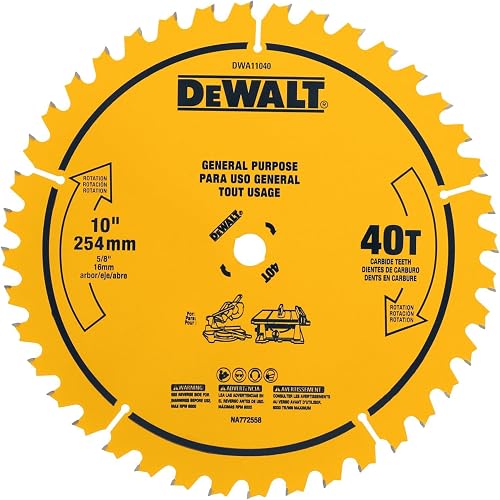
DEWALT Table Saw Blade: Best for clean 40-tooth cuts
- 10-inch diameter
- 40 teeth
- Ultra-sharp carbide
- Optimized tooth geometry
DEWALT combines a 40-tooth layout with ultra-sharp carbide and optimized geometry for accurate, clean cutting.
Pros
- Ultra-sharp carbide
- Optimized tooth geometry
- 40-tooth balance
Cons
- No thin-kerf measurement is given in the product data
The DEWALT Table Saw Blade suits woodworkers who want a 40-tooth blade with ultra-sharp carbide and optimized tooth geometry. Those features point to clean, accurate cutting while keeping the tooth count useful for general shop work.
Its 10-inch diameter and 40-tooth layout place it alongside the WEN BL1040 and Luckyway as a general-purpose option. DEWALT also identifies the blade for increased life and performance through its tooth design.
The alloy steel body and carbide cutting material give the blade a different feature mix from the thin-kerf WEN blades. This makes DEWALT a good fit when tooth geometry and carbide sharpness matter more to you than a published thin-kerf measurement.
The product data identifies it for wood cutting, so it is a focused choice for woodworking rather than a blade selected for a broad plastic or composite material range. Its 0.59 kg listed weight is also lower than several other blades in this group.
Choose it for regular table saw wood cutting and clean 40-tooth work. Its trade-off is that the available data does not give it the same stated thin-kerf advantage as the WEN, Luckyway, CMT or FOXBC blades.
TOYAKI 10-Inch Miter Saw Blade: Best for very fine crosscuts
- 120 teeth
- 5/8-inch arbor
- Wood and soft-material cutting
- High-grade steel construction
The 120-tooth pattern targets fine-finish work when smooth crosscuts matter more than fast material removal.
Pros
- Highest tooth count here
- Standard arbor size
- Broad saw compatibility
Cons
- Slower cutting pattern than 40-tooth options
The TOYAKI 10-Inch Miter Saw Blade is the choice for very fine crosscuts, with 120 teeth aimed at consistent fine-finish work. That tooth count is the highest in this group, so it suits projects where a smooth edge matters more than quick material removal.
It uses a 5/8-inch arbor and is compatible with miter saws, table saws and circular saws. The blade is designed for wood and soft materials, and its high-grade steel construction gives it a durable body material.
TOYAKI also describes an engineered tooth pattern for clean, accurate cuts with reduced vibration during use. Those features support trim work, small parts and visible crosscuts where the edge needs to look clean.
Its 2.8 mm listed thickness is different from the thinner stated kerfs on several other picks. That makes the tooth count and intended finish the main reasons to choose it, rather than a narrow-cut requirement.
The trade-off is speed and versatility. A 120-tooth blade is more specialized than a 40-tooth general-purpose blade, so choose it for fine work rather than as your only blade for heavy ripping.
Luckyway 10 Inch Table Saw Blade 40T: Best for a 2-pack
- 2 blades
- 40 tungsten carbide-tipped teeth
- 2.4 mm kerf
- Up to 5350 RPM
The 2-pack gives a shop two 40-tooth general-purpose blades, with the same thin kerf format used by several leading picks.
Pros
- Two-blade pack
- General-purpose tooth count
- 10-inch table saw compatibility
Cons
- Less suited to fine crosscuts than higher-tooth options
The Luckyway 10 Inch Table Saw Blade 40T is the best fit for a shop that wants two general-purpose blades in one purchase. Each blade has 40 tungsten carbide-tipped teeth, giving the pair a useful layout for routine wood cutting.
The blades use a 10-inch diameter, 5/8-inch arbor and 2.4 mm ultra-thin kerf. They are rated for up to 5350 RPM and fit the majority of 10-inch miter saws, jobsite saws and table saws.
A 2-pack is useful when one blade is set aside for a different material or when you want a spare ready for the next project. The general-purpose tooth count also makes the blades a better match for mixed shop work than an 80-tooth or 120-tooth blade.
The product lists compatibility with engineered wood, plastic and wood. That wider stated material range gives the pack a little more flexibility than a blade described only for standard wood cutting.
The trade-off is the focus. These are not the strongest picks for very fine crosscuts, but they offer practical coverage for ordinary wood and engineered wood cutting.
MarvTool 10-Inch 80-Tooth Woodworking Saw Blade: Best for fine crosscutting
- 80 tungsten carbide teeth
- 5/8-inch arbor
- Up to 7000 RPM
- Shock-absorbing grooves
The 80-tooth design favors fine crosscutting, while shock-absorbing grooves target heat, noise and vibration control.
Pros
- Fine 80-tooth pattern
- High stated RPM rating
- Grooves for heat and vibration control
Cons
- More specialized than a 40-tooth combination blade
The MarvTool 10-Inch 80-Tooth Woodworking Saw Blade suits fine crosscutting in wood and sheet materials. Its 80 tungsten carbide teeth give it a smoother-cut focus than the 40-tooth options.
The blade has a 5/8-inch arbor and works with most 10-inch miter saws and table saws. It is rated for speeds up to 7000 RPM, which is higher than the stated ratings of the WEN and Luckyway blades.
MarvTool also includes shock-absorbing grooves designed to dissipate heat, reduce noise and dampen vibration. The stated material range includes plywood, particleboard, multilayer board, panel board, MDF and laminated plastics.
That material list makes it useful when a project moves between solid wood and manufactured panels. The blade remains more specialized than a combination blade, but its 80-tooth layout is more directly aimed at fine crosscutting.
Choose it when clean crosscuts and a broad sheet-material range matter. The trade-off is that an 80-tooth blade is more specialized than a 40-tooth blade, so it is not the first choice for fast general-purpose ripping.
CMT Orange Tools 256.050.10: Best for combination work
- 50 teeth
- 5/8-inch arbor
- Combination design
- Thin-kerf construction
This combination blade is built for buyers who want one blade for both rip and crosscut work in wood and plywood.
Pros
- Combination tooth layout
- Thin kerf
- Suitable for softwood, hardwood and plywood
Cons
- More specialized in design than the 40-tooth general-purpose picks
The CMT Orange Tools 256.050.10 is the best option for combination table saw work, where one blade needs to handle both ripping and crosscutting. Its 50-tooth combination design sits between the general-purpose 40-tooth blades and the fine 60-tooth and 80-tooth options.
It has a 10-inch diameter, 5/8-inch arbor and a 0.102-inch kerf. CMT identifies it for softwood, hardwood and plywood, which covers many common woodworking materials.
The thin-kerf design puts less load on an underpowered saw, according to the product description. It also uses carbide teeth and a blade plate with expansion slots and an anti-vibration design.
CMT describes a laser-cut blade plate and a micrograin carbide tooth construction. Those details give this blade a more engineered design emphasis than the simpler general-purpose picks.
Choose this blade when you want a balanced combination layout rather than a dedicated rip or crosscut blade. Its trade-off is that the 50-tooth pattern is less specifically tuned than the 40-tooth general-purpose and 80-tooth fine-crosscut picks.
FOXBC 60-Tooth Thin Kerf Crosscut Blade: Best for thin-kerf crosscuts
- 60 tungsten carbide teeth
- 0.087-inch kerf
- 5/8-inch arbor
- ATB tooth design
The narrow 0.087-inch kerf and 60-tooth ATB pattern suit clean crosscuts in plywood, oak, pine, melamine and moulding.
Pros
- Narrowest stated kerf here
- 60-tooth crosscut pattern
- ATB design
Cons
- Crosscut focus gives it less range than combination blades
The FOXBC 60-Tooth Thin Kerf Crosscut Blade is the best fit for narrow, clean crosscuts. Its 0.087-inch kerf is the narrowest stated kerf in this roundup, and its 60 tungsten carbide teeth use an ATB design.
The blade has a 5/8-inch arbor and fits most 10-inch miter saws and table saws. FOXBC identifies it for oak, pine, melamine, plywood and moulding, so it suits both solid wood and several sheet or finished materials.
Its thin kerf removes little material per cut, while the 60-tooth arrangement gives it a fine-finish focus. That makes it a strong choice for parts where the cut edge is visible.
The stated compatible saw list includes DeWalt, Skil, Metabo and Makita 10-inch miter saws and table saws. Its 0.09-inch listed thickness also supports its compact thin-kerf design.
The trade-off is specialization. The crosscut layout is less flexible than the WEN BL1040 or CMT combination blade when the same blade must also handle frequent ripping.
Revvstark 80-Tooth 10-Inch Blade: Best for broad wood-material use
- 80 carbide teeth
- 5/8-inch arbor
- Up to 7000 RPM
- Noise-reducing perforations
The 80-tooth layout and broad material range make this a useful fine-cut option for wood, panels and plastic.
Pros
- 80-tooth pattern
- Thermal expansion grooves
- Broad material compatibility
Cons
- Lower score than the other 80-tooth option for this roundup's woodworking focus
The Revvstark 80-Tooth 10-Inch Blade suits woodworkers who want fine cutting across wood, panels and plastic. Its 80 tungsten carbide teeth favor a smooth edge, while the stated material range extends beyond wood.
It uses a 10-inch diameter, 5/8-inch arbor and a maximum speed of 7000 RPM. Revvstark also includes noise-reducing perforations and thermal expansion grooves for heat dissipation and quieter operation.
The blade is identified for softwood, hardwood, plywood, chipboard, panels, MDF and laminated plastics. That range gives it more material coverage than a blade described only for wood.
Its anti-kickback tooth design is another stated feature for safer cutting, while the carbide construction is intended to resist heat and abrasion. These features make it a broad fine-cut option rather than a narrowly defined crosscut blade.
Choose it for fine cuts across several panel and plastic materials. The trade-off is its lower fit for this woodworking-focused roundup compared with the MarvTool, which also has 80 teeth and adds a more specific fine-crosscut description.
How these table saw blades compare
The WEN BL1060 leads because it balances the most useful features for most readers: 60 teeth, a thin 2.4 mm kerf, carbide tips and wide 10-inch saw compatibility.
| Blade | Best use | Teeth | Kerf or design | Arbor |
|---|---|---|---|---|
| WEN BL1060 | Fine woodworking | 60 | 2.4 mm thin kerf | 5/8 in |
| WEN BL1040 | Everyday cuts | 40 | 2.4 mm thin kerf | 5/8 in |
| DEWALT | Clean general cuts | 40 | Optimized tooth geometry | Not given |
| TOYAKI | Very fine crosscuts | 120 | Fine-finish pattern | 5/8 in |
| Luckyway | Two-blade coverage | 40 | 2.4 mm thin kerf | 5/8 in |
| MarvTool | Fine crosscutting | 80 | Shock-absorbing grooves | 5/8 in |
| CMT | Combination work | 50 | 0.102 in thin kerf | 5/8 in |
| FOXBC | Narrow crosscuts | 60 | 0.087 in thin kerf, ATB | 5/8 in |
| Revvstark | Wood and plastic | 80 | Thermal expansion grooves | 5/8 in |
The most important split is tooth count. The 40-tooth WEN, DEWALT and Luckyway blades are easier starting points for mixed work, while the higher-tooth blades target smoother edges.
Kerf creates another useful split. FOXBC has the narrowest stated kerf, the WEN and Luckyway blades use 2.4 mm, and CMT uses 0.102 inch.
DEWALT and TOYAKI do not provide a kerf measurement in the data.
For plywood-specific work, compare these choices with our guide to the best plywood blade for a table saw. A clean blade still needs a stable workpiece and a controlled feed.
How we compared the best saw blades for woodworking table saws
We compared each blade by diameter, arbor, tooth count, kerf, material range and stated design. We then matched those features to common woodworking needs such as general cutting, fine crosscutting, plywood work and using one blade for several tasks.
The score also reflects how directly each product fits the search. A 40-tooth blade earns value for general work, while an 80-tooth or 120-tooth blade earns value when its finer layout matches a clear finishing need.
Compatibility comes before tooth count. A blade that does not match the saw's diameter, arbor or speed rating is not a useful choice, even if its tooth pattern suits the project.
We also separated facts from promises. A named feature such as a 2.4 mm kerf, 60 carbide-tipped teeth or 0.087-inch kerf is a direct comparison point.
A claim about longer life remains a brand claim, not a guarantee.
When a product gave no arbor, kerf or speed detail, we kept that limitation visible instead of filling the gap with an assumption. That is why the DEWALT table row shows no arbor and why its trade-off differs from the WEN and FOXBC options.
What tooth count should you choose?
Choose a 40-tooth blade for mixed woodworking, a 60-tooth blade for a cleaner all-around finish, and 80 to 120 teeth for fine crosscuts.
40 teeth for everyday work
The WEN BL1040, DEWALT and Luckyway are the clearest choices for routine cutting. Their tooth counts support general-purpose wood work, and the WEN and Luckyway add a stated 2.4 mm thin kerf.
Pick the WEN BL1040 when you want one blade. Pick Luckyway when having two blades matters.
Pick DEWALT when optimized tooth geometry and ultra-sharp carbide are your deciding features.
60 to 80 teeth for cleaner edges
The WEN BL1060 and FOXBC use 60 teeth, while MarvTool and Revvstark use 80. These layouts favor smoother cuts than 40-tooth blades.
Pick the WEN BL1060 for the best balance. Pick FOXBC when the narrowest stated kerf matters, and choose MarvTool when its fine-crosscut focus and shock-absorbing grooves fit your work.
120 teeth for very fine work
The TOYAKI blade is the most specialized option here. Its 120-tooth pattern suits fine finishing, but it is not the best choice for fast ripping or as the only blade in a mixed-use shop.
Is a thin-kerf blade better for a table saw?
A thin-kerf blade is better when you want a narrower cut and less material removed from each pass. It can also suit a saw where reducing the cut width supports easier feeding.
The WEN BL1060, WEN BL1040 and Luckyway state a 2.4 mm kerf. CMT states a 0.102-inch kerf, and FOXBC states a narrower 0.087-inch kerf.
Thin kerf does not automatically mean the blade is best for every job. Tooth count still controls the cut's purpose, so use a 40-tooth thin-kerf blade for general work and a 60-tooth thin-kerf blade when a cleaner edge matters more.
The practical comparison is between cut width and the type of work. A narrow kerf helps reduce material removal, while a higher tooth count changes the blade toward smoother, more specialized cuts.
Which blade is best for plywood and sheet goods?
The MarvTool is the strongest broad sheet-material choice because it names plywood, particleboard, multilayer board, MDF and laminated plastics. FOXBC is a close fit for plywood, melamine and moulding, especially when its narrow kerf helps your cuts.
CMT is the better combination choice for plywood when you also want to rip and crosscut softwood and hardwood. Its 50-tooth layout sits between the faster 40-tooth blades and the smoother high-tooth options.
Revvstark also covers plywood, chipboard, MDF, panels and laminated plastics. Its 80-tooth layout makes it more suited to fine cuts across those materials than to fast general-purpose ripping.
For a dedicated plywood project, start with the blade's tooth count and kerf, then consider the material range. Our guide to a table saw featherboard can also help you plan steadier feeding for long sheet goods.
Can one blade handle ripping and crosscutting?
Yes. A 40-tooth general-purpose blade or a 50-tooth combination blade is the best starting point when you want one blade for both tasks.
The WEN BL1040 is the straightforward single-blade choice. The CMT Orange Tools 256.050.10 is the more purpose-built combination choice, with a 50-tooth design for softwood, hardwood and plywood.
A 60-tooth blade can also handle mixed woodworking, but it puts more emphasis on a clean finish. The WEN BL1060 is the best overall compromise when you want one blade that leans toward fine work without moving to a specialized 80-tooth or 120-tooth pattern.
If you frequently switch between ripping and crosscutting, the 40-tooth choices are easier to justify. If the cut edge is more important than speed, moving up to 60 teeth gives the blade a finer focus.
What should you check before installing a blade?
Check the blade diameter, arbor size, tooth direction and speed rating against the saw before installation. Most products here are 10-inch blades with a 5/8-inch arbor, but the stated speed ratings vary.
The WEN blades are rated up to 6000 RPM, Luckyway up to 5350 RPM, and MarvTool and Revvstark up to 7000 RPM. TOYAKI uses a 5/8-inch arbor, while CMT and FOXBC also state 5/8-inch arbor sizes.
Keep the teeth clean and choose the blade for the material. Resin, glue and laminated surfaces can change how a blade cuts, so a blade selected for plywood or sheet goods is more useful than forcing a general-purpose blade through every project.
A stable setup matters as much as the blade. Use an appropriate fence, support long stock and keep hands away from the cutting path.
Also check whether the blade's stated compatibility covers your exact saw type. Several picks list table and miter saw compatibility, but that does not remove the need to confirm the saw's diameter, arbor and maximum speed.
Verdict: which blade should you buy?
The WEN BL1060 is the best saw blade for woodworking table saws for most people. Its 60 carbide-tipped teeth, 2.4 mm thin kerf, 10-inch size and broad compatibility give it the most balanced fit across ordinary woodworking projects.
Choose the WEN BL1040 for faster general-purpose work, DEWALT for optimized 40-tooth cutting, or Luckyway when a 2-pack is useful. For special jobs, choose TOYAKI for very fine crosscuts, MarvTool or Revvstark for 80-tooth work, CMT for combination cuts, and FOXBC for a narrow crosscut kerf.
If you're still choosing the saw itself, compare the blade with a table saw for woodworking in a home shop before you buy. The best blade is the one whose diameter, arbor, speed and tooth pattern match both your saw and the cuts you make most often.
Our top 3 picks at a glance
-
1
Best for fine woodworking
WEN BL1060 10-Inch 60-Tooth Fine-Finish Professional Woodworking
9.7/10 our score
See it on Amazon -
2
Best for everyday cuts
WEN BL1040 10-Inch 40-Tooth Carbide-Tipped Professional Woodworking
9.6/10 our score
See it on Amazon -
3
Frequently asked questions
What tooth count is best for a table saw blade?
A 40-tooth blade is the most useful general-purpose choice, while 60 to 80 teeth favor smoother crosscuts. A 120-tooth blade suits very fine finishing work but removes material more slowly.
Can a table saw use a miter saw blade?
Some blades are designed for both tools, but the diameter, arbor and stated compatibility still need to match the saw. Several picks here list compatibility with both 10-inch table saws and miter saws.
What blade is best for plywood?
A higher-tooth crosscut blade is the better starting point for clean plywood edges. The FOXBC has 60 teeth and a 0.087-inch kerf, while the MarvTool and Revvstark use 80-tooth layouts.
How often should a table saw blade be changed?
Change the blade when its cut quality no longer suits the work, its teeth are damaged, or the blade no longer matches the material and cut type. Keep a general-purpose blade and a fine-finish blade for different jobs.


