8 Best Miter Gauges for Table Saws (October 2026)
The best miter gauges for table saws include the INCRA MITER1000SE Miter Gauge for batch crosscuts, the Kreg KMS7102 Precision Miter Gauge for adjustable-fence buyers, and the VEVOR Precision Miter Gauge for wide stock.
On this page (8 sections)
- Which table saw miter gauges made the cut?
- The best miter gauges for table saws
- How should you choose a table saw miter gauge?
- When do a fence and flip stop help?
- How do you set up and use a table saw miter gauge?
- What mistakes make miter gauge cuts less reliable?
- How do you care for a miter gauge?
- Which table saw miter gauge should you choose?
The INCRA MITER1000SE is the best table saw miter gauge for repeatable cuts, with a telescoping fence, flip stop and 41 angle stops. The Kreg is a complete gauge and adjustable-fence system, while the compact GOINGMAKE suits portable saws.
A miter gauge guides stock through crosscuts and angled cuts by sliding in a slot on the saw table. Your best choice depends on whether the gauge fits that slot, how much fence support you need and how often you repeat a cut length.
Start with our table saw setup and choosing guide if you're still comparing saws. For other parts that fit into the table, see our guide to table saw zero-clearance inserts and our explanation of table saw blade sizes.
Our picks at a glance
-
1

-
2
 Best for adjustable-fence buyers
Kreg KMS7102 Precision Miter Gauge
8.4/10 our score
See it on Amazon -
3

- 4
 Check it
VEVOR Miter Gauge With 18-Inch Fence
Best for shorter workpieces - 5
 Check it
POWERTEC 71391 Miter Gauge With 27 Stops
Best for all-in-one setups - 6
 Check it
WEN Steel and Brass Miter Gauge
Best for multi-tool shops - 7
 Best for custom fencesCheck it
- 8
 Best for portable sawsCheck it
Which table saw miter gauges made the cut?
The INCRA MITER1000SE leads for its adjustable fence and repeat-cut stop, while the other gauges suit compact, simpler or more specialized setups. We compared stated angle stops, fence features, bar adjustments and slot compatibility against common table saw needs.
| Product | Best for | Angle stops | Fence | Slot fit | Our score |
|---|---|---|---|---|---|
| INCRA MITER1000SE Miter Gauge | batch crosscuts | 41 laser-cut V-stops | 18–31 in telescoping fence | GlideLOCK bar with 6 expansion points | 9.0 |
| Kreg KMS7102 Precision Miter Gauge | adjustable-fence buyers | Adjustable | 8.4 | ||
| VEVOR Precision Miter Gauge | wide stock | 15 positive stops | 19–35 in retractable fence | 3/4 x 3/8 in standard slots | 8.1 |
| VEVOR Miter Gauge With 18-Inch Fence | shorter workpieces | 15 positive stops | 18 in | 3/4 x 3/8 in standard slots | 7.9 |
| POWERTEC 71391 Miter Gauge With 27 Stops | all-in-one setups | 27 stops with 1-degree spacing | 24 x 3 in multi-track fence | 3/4 x 3/8 in slots; not 5/8 in slots | 7.7 |
| WEN Steel and Brass Miter Gauge | multi-tool shops | 27 positive stops | 3/4 x 3/8 in standard slots | 7.5 | |
| INCRA Miter V27 Miter Gauge | custom fences | 27 stops | Supports a user-made fence | 7.3 | |
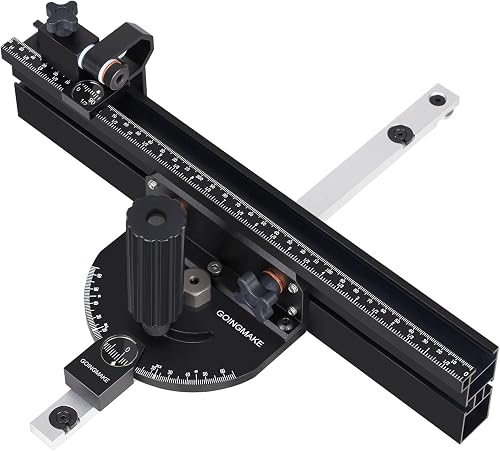
| GOINGMAKE Compact Miter Gauge | portable saws | 11 positive stops | 360 mm | 3/4 x 3/8 in T and U slots | 7.0 |
The best miter gauges for table saws
The best miter gauge for your saw depends on your slot dimensions and the workpieces you cut most often. These picks are ordered by score, from the most adjustable fence system to a compact option.
INCRA MITER1000SE Miter Gauge: Best for batch crosscuts
- 41 laser-cut V-stops
- 18–31 in telescoping fence
- GlideLOCK miter bar with 6 expansion points
- Flip shop stop
A telescoping fence and flip stop help with repeat cuts across different stock widths. Its 41 V-stops cover popular angles.
Pros
- Telescoping fence
- Flip stop for repeat cuts
- 41 angle stops
Cons
- Long fence may be more than a small shop needs
The INCRA MITER1000SE suits repeatable crosscuts and angled cuts where fence support and stop placement matter. Its 18–31 in telescoping fence extends for wider stock and retracts when a shorter setup is easier to manage.
INCRA gives it 41 laser-cut V-stops and an engraved stainless steel primary scale. The GlideLOCK bar has six expansion points to help adjust its fit in the miter slot.
The included Flip Shop Stop lets you set a stop along the fence, then move it out of the way without changing its position. This is useful when a batch alternates between stopped and unstopped cuts.
Buy it for repeat cuts and changing stock widths. Skip it if you rarely use a stop or don't need an extending fence.
Kreg KMS7102 Precision Miter Gauge: Best for adjustable-fence buyers
- Adjustable fence
- Designed for accurate, repeatable angle cuts
- Smooth miter-slot operation
- Factory-calibrated gauge
Kreg pairs an adjustable fence with a factory-calibrated gauge for buyers who want a complete gauge and fence system.
Pros
- Adjustable fence
- Factory-calibrated gauge
- Designed for repeatable angle cuts
Cons
- Slot dimensions aren't specified
The Kreg KMS7102 is a complete miter gauge system with an adjustable fence. It suits woodworkers who want a fence included instead of building one for a bare gauge.
Kreg describes the system as factory-calibrated and designed for accurate, repeatable angle cuts. Its stated features also emphasize smooth movement in the miter slot and durable construction for frequent workshop use.
The slot dimensions aren't specified, so compare the gauge with your saw before choosing it. That check matters if your saw has an uncommon slot size or shape.
Buy it for an adjustable fence and a ready-to-use system. If compatibility is uncertain, confirm it with Kreg or your saw's manufacturer.
VEVOR Precision Miter Gauge: Best for wide stock
- 19–35 in retractable fence
- 15 positive angle stops
- Fits stated 3/4 x 3/8 in standard slots
- Adjustable spring-loaded plunger
The long retractable fence supports wider stock. Its removable disc fits stated T-shaped and U-shaped standard slots.
Pros
- Long adjustable fence
- 15 angle stops
- Adjustable bar fit
Cons
- Measure your miter slot before buying
The VEVOR Precision Miter Gauge fits buyers who want an adjustable fence that extends from 19 to 35 in. Its 15 positive stop holes include 90 degrees and common angles such as 22.5, 30, 45 and 60 degrees.
The steel bar has an adjustable spring-loaded plunger. VEVOR specifies a 3/4 x 3/8 in standard slot fit and a removable disc for T-shaped and U-shaped slots, so measure your saw before ordering.
It arrives partially assembled, with a few core components left to attach. The aluminum alloy head and laser-engraved scale complete a setup aimed at users who want fence reach and indexed angles.
Buy it for a long retractable fence and common angle stops. Skip it if your slot dimensions or shape don't match the stated fit.
VEVOR Miter Gauge With 18-Inch Fence: Best for shorter workpieces
- 18 in fence
- 15 positive angle stops
- Fits stated 3/4 x 3/8 in standard slots
- Adjustable spring-loaded plunger
This VEVOR uses the same style of positive stops and adjustable bar fit as its longer-fence counterpart. The 18 in fence suits a more compact cutting setup.
Pros
- 18 in fence
- 15 angle stops
- Adjustable bar fit
Cons
- Measure your miter slot before buying
This VEVOR model uses the same stated standard slot fit and 15 positive stops as the longer version, with an 18 in fence. That shorter reach suits a compact cutting setup or workpieces that don't need as much fence support.
Its spring-loaded plunger adjusts to reduce gaps in the slot. VEVOR describes it as partially assembled, with an aluminum alloy head and laser-engraved angle scale.
Measure your saw's slot before buying. VEVOR specifies a 3/4 x 3/8 in standard slot and a removable disc for T-shaped and U-shaped slots.
Buy it for a shorter fence with common angle stops. Choose a longer or telescoping fence if your stock needs more support.
POWERTEC 71391 Miter Gauge With 27 Stops: Best for all-in-one setups
- 27 angle stops
- 24 x 3 in multi-track fence
- Flip stop
- Fits stated 3/4 x 3/8 in slots
The set includes a gauge, multi-track fence and flip stop. Check your slot because this set doesn't fit 5/8 in miter slots.
Pros
- Gauge, fence and flip stop included
- 27 angle stops
- Fence has a measuring scale
Cons
- Does not fit 5/8 in miter slots
POWERTEC bundles a gauge, 24 x 3 in multi-track fence and flip stop. The gauge has 27 angle stops with 1-degree spacing, including positive stops at common angles such as 0, 22.5, 30 and 45 degrees.
The fence has a laser-engraved measuring scale and tracks for compatible accessories. You can position the flip stop on either the left or right side, which gives you options when arranging a cut.
Check the miter slot before choosing this set. POWERTEC states that it fits standard 3/4 x 3/8 in slots, with or without T-slots, but excludes 5/8 in slots and smaller saws.
Buy it for a gauge, fence and stop in one set. Skip it if your saw has a 5/8 in slot or a smaller slot.
WEN Steel and Brass Miter Gauge: Best for multi-tool shops
- 27 positive stops
- Steel and brass construction
- Fits stated 3/4 x 3/8 in standard slots
- Expansion discs help adjust side play
WEN's steel-and-brass gauge has expansion discs to help adjust the bar in the slot. Its stated standard-slot design also suits several other woodworking tools.
Pros
- 27 positive stops
- Steel and brass construction
- Expansion discs included
Cons
- Fence isn't included
The WEN Steel and Brass gauge suits buyers who want a metal gauge with 27 positive stops. WEN says it works with standard 3/4 x 3/8 in slots and names several of its own table saw and band saw models as compatible.
Expansion discs help adjust side-to-side play in the miter slot. WEN also includes a T-track disc for T-shaped and U-shaped slots, brass lock knobs and a laser-etched scale.
This gauge can also be used with router tables, band saws and other tools with the stated standard slot. It doesn't include a fence, so plan to use a compatible fence or make one if your cuts need more support.
Buy it for a steel and brass gauge that can move between tools. Choose a system with an included fence if you need one in the box.
INCRA Miter V27 Miter Gauge: Best for custom fences
- 27 angle stops
- Four expansion points
- Supports a user-made fence
- Compact design
The V27 keeps the gauge compact and supports a fence you make yourself. Four expansion points help adjust side play in the slot.
Pros
- Compact design
- Four expansion points
- Supports a custom fence
Cons
- Fence isn't included
The INCRA Miter V27 keeps the setup compact and focused on the gauge itself. It has 27 angle stops and four expansion points to adjust side play in the miter slot.
Its universal mounting bracket supports a user-made fence, letting you choose the length and shape that suit your saw and work. You will need to supply or build that fence separately.
Buy it for a compact gauge with room to add your own fence. If you want a fence and stop included, consider the INCRA MITER1000SE or POWERTEC set instead.
GOINGMAKE Compact Miter Gauge: Best for portable saws
- 360 mm fence
- 11 positive angle stops
- Flip stop
- Fits stated 3/4 x 3/8 in T and U slots
The compact fence and flip stop suit portable jobsite saws. Its stated slot fit covers 3/4 x 3/8 in T and U slots.
Pros
- Compact fence
- Flip stop included
- Adjusters at several points on the bar
Cons
- Fewer positive stops than the other picks
The GOINGMAKE Compact Miter Gauge is designed for portable jobsite table saws, with a 360 mm fence and flip stop. Its 11 positive stops cover common angles, including 15, 22.5, 30, 45, 60 and 90 degrees.
The gauge fits 3/4 x 3/8 in T and U slots. Adjustment points at the front, middle and end of the bar help set its fit in the slot.
A laser scale allows settings between positive stops. The fence also has millimeter and inch scales, and the flip stop is designed for repeatable cut setup.
Buy it for a compact fence and stop on a portable saw. Measure your slot before buying and confirm the gauge leaves enough room on your table.
How should you choose a table saw miter gauge?
Measure the slot first, then choose the fence and angle features to match your work. A gauge that doesn't fit the slot can't guide stock as intended.
Which slot fit matters for a table saw miter gauge?
Many of these picks state compatibility with a 3/4 x 3/8 in slot, but the POWERTEC specifically excludes 5/8 in slots. Some gauges include a removable disc for T-shaped and U-shaped slots, so check both the slot size and shape.
Measure the slot at the table rather than relying on the saw's brand or model family. If the gauge's fit is unclear, ask the gauge or saw maker before buying; a bar that binds or rocks is a poor base for controlled cuts.
How much fence length do your cuts need?
Fence length affects how much of a workpiece can rest against the gauge. The INCRA's telescoping fence offers an 18–31 in range, while the VEVOR models have a 19–35 in extending fence or an 18 in fence.
A longer fence can help keep wide stock aligned, but it also needs room to move. Consider your longest common crosscuts, table space and nearby walls or tools before choosing a fence that extends well past the saw top.
Which stops help with the angles you cut?
Angle stops make frequent settings faster to return to, but compare the actual positions instead of picking by count alone. INCRA's MITER1000SE has 41 V-stops, POWERTEC and WEN each have 27, and GOINGMAKE has 11 positive stops.
If you often cut a less common angle, a readable scale and secure lock may be more useful than a high stop count. For occasional angled work, focus first on slot fit and a stable workpiece reference.
When do a fence and flip stop help?
A fence supports the workpiece, and a flip stop helps repeat a cut length. These features can reduce setup steps when you make several parts to the same size.
The INCRA MITER1000SE has a telescoping fence and flip stop. POWERTEC includes both in its set, while the INCRA V27 supports a user-made fence but doesn't include one.
Think about the widest pieces you cut and how often you repeat lengths. For more control when guiding stock in a rip cut, a table saw featherboard serves a different role from a miter gauge and may suit that setup.
How do you set up and use a table saw miter gauge?
Set the bar to slide smoothly without noticeable side play, then verify the gauge's angle against the blade before making a workpiece cut. Follow the gauge and saw manuals for adjustment and safe operation.
Start with the saw unplugged while fitting or adjusting the gauge. Clean dust and chips from the miter slot, place the bar in the slot, and adjust its expansion points or plunger as directed until it moves freely without rocking.
Set the gauge to 90 degrees and check it against the blade with a reliable square. If the gauge has a calibration adjustment, follow its instructions; otherwise, note any offset and account for it before cutting.
Recheck the angle after locking the gauge.
For a batch, set the fence and stop with the saw off, then make a trial cut in scrap. Check both the angle and length before cutting project stock, and keep the workpiece flat against the fence as you guide it through.
Use only a setup that gives the stock secure support and keeps hands clear of the blade path. A miter gauge controls the crosscut angle, but safe handling also depends on the saw's guard, riving knife and other features.
See our guide to table saw safety features before changing the saw's cutting setup.
What mistakes make miter gauge cuts less reliable?
Most avoidable errors come from a poor slot fit, an unchecked angle or a workpiece that shifts against the fence. A careful setup and a scrap cut can reveal these problems before they affect project parts.
Don't assume a gauge fits because it came with a familiar brand or because the slot looks close. Measure width and depth, check the slot shape, and confirm compatibility before forcing the bar into place.
Don't trust a printed scale or positive stop without checking the actual blade angle. Small alignment errors can show up across a wide panel or a set of matching parts, so verify the setting when accuracy matters.
Avoid changing the fence or stop after beginning a batch unless you reset and confirm the dimension. Keep the workpiece seated against the fence, and don't use a stop in a way that traps offcuts against the blade.
How do you care for a miter gauge?
Keep the bar and slot clean, and check the fit whenever the gauge starts to drag or wobble. Dust and small chips can interfere with smooth travel and make a familiar setup feel different.
Brush debris from the slot and gauge after use, then wipe the gauge dry before storage. Avoid leaving a fence extended where it can be bumped, and recheck the stop and angle lock after moving or storing the gauge.
If the bar has expansion points or a spring-loaded plunger, use the adjustment method provided for that gauge. Make small changes and slide it through the full slot length to confirm the fit stays smooth.
Which table saw miter gauge should you choose?
Choose the INCRA MITER1000SE for repeat cuts across changing stock widths, the Kreg for an adjustable-fence system, or the POWERTEC set when you want the fence and flip stop included. Pick the GOINGMAKE for a compact portable-saw setup, and the VEVOR 18 in model if a shorter fence fits your work.
The INCRA V27 and WEN make more sense when you have a fence plan already, while the longer VEVOR is a fit for wider stock that needs more support. Whichever model you choose, measure the slot and check the angle before cutting valuable material.
For other accessory choices, browse our table saw blades and add-ons guide and compare the best dado sets for table saws.
Our top 3 picks at a glance
-
1
-
2
Best for adjustable-fence buyers
Kreg KMS7102 Precision Miter Gauge
8.4/10 our score
See it on Amazon -
3
Frequently asked questions
How do I choose a table saw miter gauge?
Start by measuring your saw's miter slot, then decide whether you need a fence and stop for repeat cuts. A longer fence gives more support to wide stock, while a compact gauge takes up less room.
Match the gauge's stated slot dimensions and shape to your saw before buying.
Do all table saws use the same miter slot size?
No. Several picks here are made for standard 3/4 x 3/8 in slots, but POWERTEC says its set doesn't fit a 5/8 in slot.
Measure the slot on your saw and check whether it is T-shaped or U-shaped.
A stated fit for one size or shape doesn't guarantee a fit for another.
What does a miter gauge fence do?
A fence gives the workpiece a longer face to rest against as you guide it through a crosscut or angled cut. A stop can help you repeat a cut length without measuring every piece again.
Choose a fence long enough for the stock you cut, while leaving space to move the gauge.
Are more angle stops always better?
More stops can make common angles quicker to set, but you still need to confirm the gauge is set for the cut you want. The INCRA MITER1000SE has 41 stops, while the compact GOINGMAKE has 11.
If you often use unusual angles, look for a readable scale and a secure way to lock the setting.


